Before I retired, I thought taxes were going to be simple. I assumed I'd have much more flexibility managing my investment portfolio because I'd be in a much lower income tax bracket, and I wouldn't have to worry about long-term capital gains tax. Boy, was I wrong.
The RMD Surprise
I had heard of RMDs but didn't really comprehend the impact. RMDs (Required Minimum Distributions) start at age 73 or 75 depending on your birth year. You must withdraw a minimum amount each year based on an IRS formula:
RMD = Prior year-end account balance ÷ IRS life expectancy factor
The life expectancy factor comes from the IRS Uniform Lifetime Table and decreases every year, meaning the percentage you're required to withdraw grows as you age:
| Age | IRS Factor | Approx. % of Balance | RMD on $1M IRA |
|---|---|---|---|
| 73 | 26.5 | ~3.8% | $37,736 |
| 75 | 24.6 | ~4.1% | $40,650 |
| 78 | 22.0 | ~4.5% | $45,455 |
| 80 | 20.2 | ~5.0% | $49,505 |
| 85 | 16.0 | ~6.3% | $62,500 |
| 90 | 12.2 | ~8.2% | $81,967 |
| 95 | 8.9 | ~11.2% | $112,360 |
| 100 | 6.4 | ~15.6% | $156,250 |
And remember, those RMD amounts are on top of Social Security and any other income you have, all taxed as ordinary income.
My Situation
I was a good saver and always maxed my 401(k) contributions. I had read about Roth IRAs but never contributed, because my goal was always to minimize current taxes, thinking things would be simpler once I retired. I was also earning above the income limit for direct Roth IRA contributions, so it was never really on the table.
I also made some good investments in my taxable account and typically held on to them because I didn't want to pay the capital gains tax. I bought Bitcoin at $6,000 and Apple at $21. My portfolio has a lot of unrealized gains, and it would be nice to reduce my exposure to some of the riskier holdings and lock in those gains.
The Roth Lesson I Learned the Hard Way
Once I retired and started researching, I realized I was going to face a substantial tax burden once RMDs kicked in. Converting as much of my IRA to Roth as possible became the most important thing I could do to avoid future taxes, both for myself and my heirs.
The first January after retiring, I immediately deposited the $8,000 maximum into a newly created Roth IRA. Oops. I hadn't done my homework carefully enough: you can only contribute earned income into a Roth, and being retired, I had no earned income. I was able to withdraw the funds before the end of the year without penalty, but I did have to pay tax on the small amount of appreciation that had accumulated in the account.
Lesson learned: Roth conversions (moving money from a traditional IRA to a Roth) are different from Roth contributions (depositing new money). Conversions have no earned income requirement.
What Is the Tax Valley?
When you convert assets from a traditional IRA to a Roth, you must treat the converted amount as ordinary income and pay taxes at your marginal rate. This is why the Tax Valley is so important.
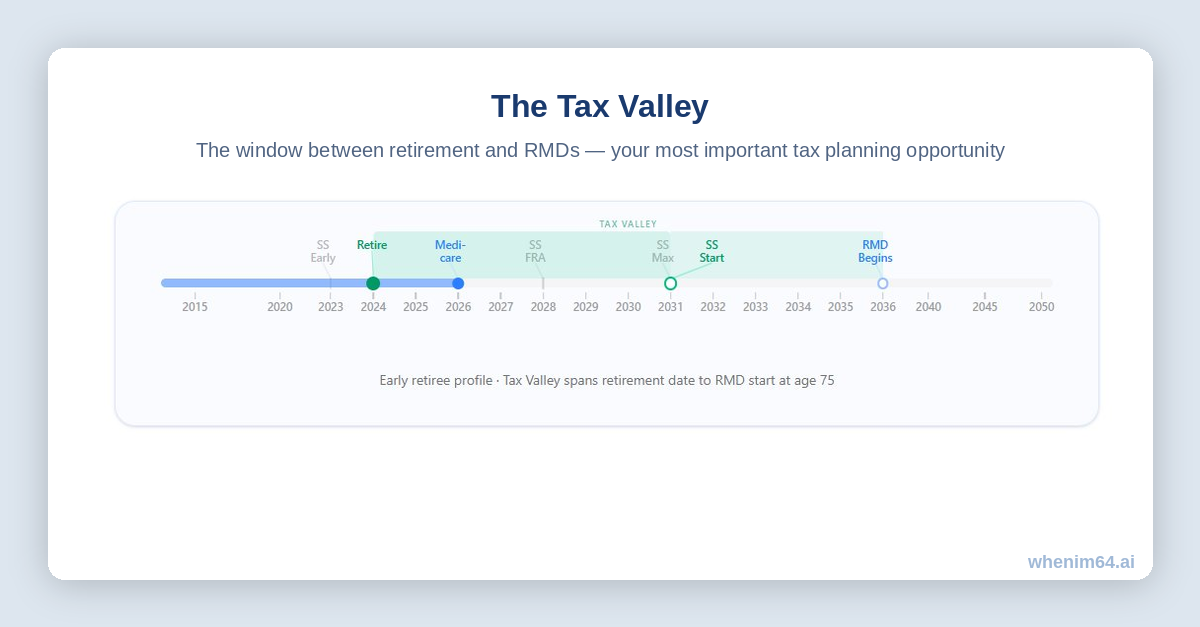
The Tax Valley is the window of years between when you stop working, your W-2 income disappears, and when Social Security starts and RMDs kick in. During this period, your taxable income may be at its lowest point for the rest of your life. This is the time when you have the flexibility to convert larger amounts of your IRA into Roth without being crushed by taxes and IRMAA.
(IRMAA is a story for another day, but think of it as an additional tax. It is actually a surcharge on top of your Medicare Part B and Part D premiums, triggered when your MAGI crosses certain income thresholds.)