My gut says most people get Roth conversions wrong. I suspect plenty of paid planners do too. Not because the math is hard, but because one input gets skipped.
Read a dozen articles on Roth conversions and they agree on the rule: convert when your heirs will pay a higher tax rate than you pay today. Then almost none of them ask who your heirs are, how many there are, or what they'll earn. That one question can swing the answer from "convert a lot" to "barely bother".
I ran dozens of households through WhenIm64's conversion strategies, from a $200,000 IRA to a $10 million one, under different assumptions about who inherits. Here's what I learned about choosing.
The Number That Matters
If you compare conversion plans by your own lifetime tax bill, not converting often looks cheapest. That's an illusion. The tax hasn't gone away. It's been handed to your heirs.
Since the SECURE Act, most heirs must empty an inherited IRA within 10 years, on top of their own income. So the honest scoreboard is the net estate: your Roth, plus your taxable account, plus your IRA after the tax your heirs pay to empty it. A Roth passes tax-free. Heirs still have to empty an inherited Roth within 10 years, but they owe nothing on it.
Every figure in this article is in today's dollars. A plan that runs to 2055 produces 2055 balances, and comparing those with today's tax brackets is how you end up thinking your kids will pay 37%. Tax brackets rise with inflation, and so, usually, do your children's paychecks.
Where Each Strategy Stops
A conversion strategy is really a decision about where to stop each year. Two things set the stopping points: the federal tax brackets, and IRMAA, the surcharge higher-income retirees pay on Medicare Part B and Part D premiums. They work very differently.
Tax brackets are progressive. Cross into the next one and only the dollars above the line pay the higher rate, so landing a little over costs a little. What matters is the size of each step, and the brackets come in near-flat pairs: 22% and 24%, then 32% and 35%. Going from 22% to 24% costs two points and opens about $190,000 of room for a married couple. The real jump is 24% to 32%, eight points at once.
IRMAA is the real cliff. Each step is a flat surcharge on both spouses' premiums, and one dollar over a threshold puts you in the next tier for the whole year. So each WhenIm64 strategy fills a tax bracket before Medicare, and once you're on Medicare stops just under an IRMAA threshold:
| Strategy |
Before Medicare, fill to |
On Medicare, stay under (2026, married) |
Surcharge for the couple |
| Conservative |
12% bracket |
$218,000: no surcharge |
$0 |
| Moderate |
22% bracket |
$274,000: 1st surcharge |
about $2,300 a year |
| Aggressive |
24% bracket |
$342,000: 2nd surcharge |
about $5,800 a year |
| Maximum |
35% bracket |
$750,000: below the top surcharge |
about $12,700 a year |
IRMAA looks back two years, so these limits apply to income two years before the premium year. WhenIm64 stays about 5% under each threshold, so a surprise fund distribution doesn't push you over.
Why no 32% strategy? For a married couple on Medicare, the 24% bracket runs to roughly $440,000 of income once deductions are added back. The third IRMAA step ends at $410,000. A strategy that stopped there would never reach 32%. It would just pay a bigger surcharge for a little more room, and in my testing it never beat Aggressive or Maximum.
Tax Paid Early Costs More Than It Looks
Add up 30 years of tax the plain way and the most aggressive plan can look cheapest. It pays its tax in the first few years, in small, early dollars. The gentler plans pay later, on RMDs and conversions in inflated 2040s dollars.
That comparison is wrong. A dollar of tax paid in 2027 leaves your taxable account for good, along with 25 years of growth. A dollar paid in 2050 stays invested until then. So WhenIm64 shows your lifetime tax as a present value, discounting each year's tax at your plan's growth rate. On that basis, the plan that pays the most up front shows the highest tax, which is what it actually costs you.
The Morrisons
The Morrisons are the WhenIm64 demo couple, in Austin. James is 66, retired, and on Medicare. His wife is 62 and earns $220,000 until she retires in 2029. They have $2.3 million in pre-tax accounts, $1.2 million in a taxable account and $150,000 in a Roth.
| Strategy |
Your lifetime tax (present value) |
Heirs' tax |
Net estate |
Survivor's RMD |
| None |
$682,000 |
$317,000 |
$4.20M |
$129,000 a year |
| Conservative |
$697,000 |
$265,000 |
$4.22M |
$107,000 a year |
| Moderate |
$857,000 |
$0 |
$4.19M |
None |
| Aggressive |
$866,000 |
$0 |
$4.17M |
None |
| Maximum |
$960,000 |
$0 |
$4.00M |
None |
Today's dollars, with two children earning $150,000 each and the plan running to 2055.
Look at the net estate column. None, Conservative, Moderate and Aggressive land within $50,000 of each other on more than $4 million. Conservative edges ahead by $24,000. Maximum converts the whole IRA by 2030, paying up to 35% on money their children would have paid 22% to 24% on, and gives up $220,000.
When strategies land within 1% of each other, the net estate can't pick. WhenIm64 then picks the one that leaves a surviving spouse the smallest RMD, and after that the gentler one. For the Morrisons that's Moderate. It gives up about $30,000 against Conservative and empties the IRA by 2050, when James is 90.
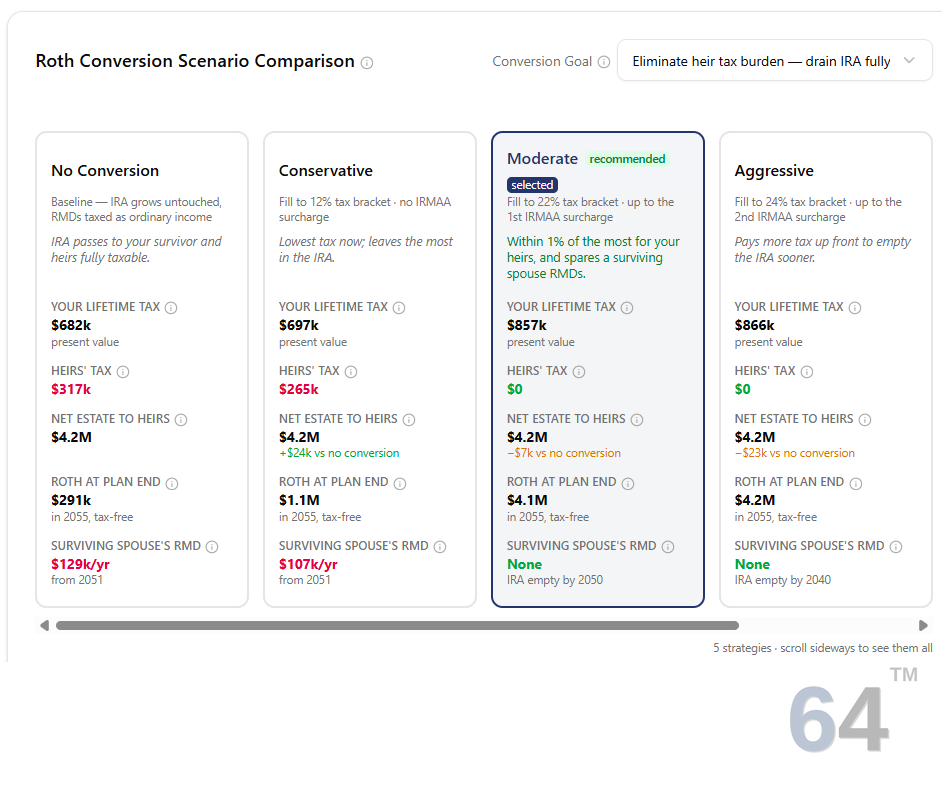
The Morrisons' strategy cards. Moderate is recommended: within 1% of the most for their heirs, and it spares a surviving spouse RMDs.
Her salary matters too. Until 2029, $220,000 of wages uses up most of the room under each tax bracket and IRMAA threshold, so the real converting starts when she retires.
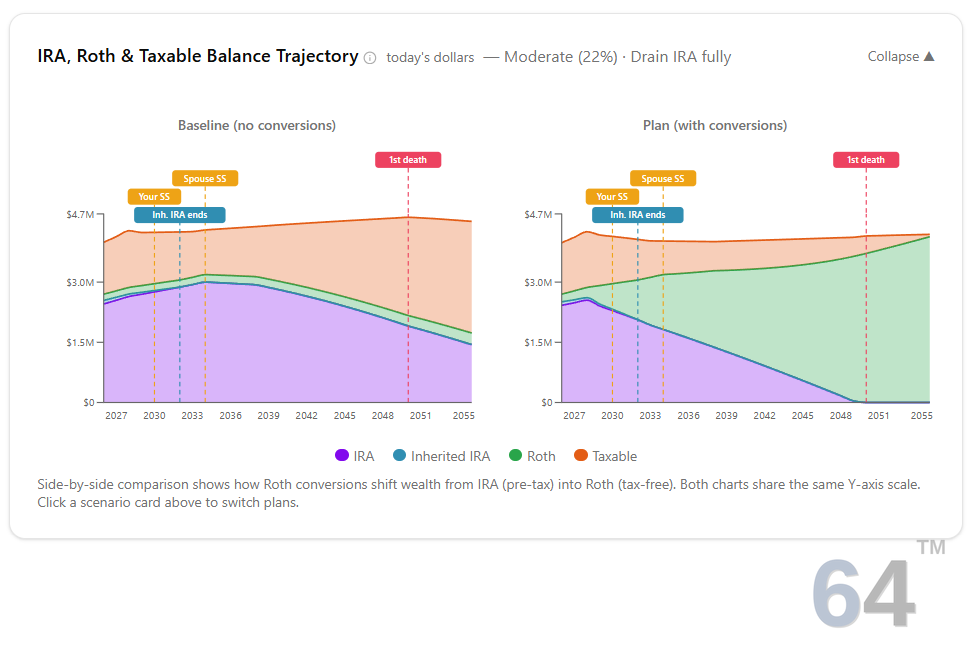
Without conversions, the IRA (purple) is still $1.4 million in 2055. Under Moderate it moves into the Roth (green) and is empty by 2050.
Who Inherits Changes the Answer
Here's what surprised me. Assume one heir pays the top 37% rate on the whole IRA, as many quick rules of thumb do, and Moderate looks $210,000 better for the Morrisons than not converting. With two children earning $150,000 each, Moderate comes out $7,000 behind.
| Who inherits the Morrisons' IRA |
No conversion |
Conservative |
Moderate |
WhenIm64 picks |
| One heir at 37% on everything |
$3.98M |
$4.04M |
$4.19M |
Moderate |
| Two children earning $75,000 |
$4.31M |
$4.34M |
$4.19M |
Conservative |
| Two children earning $150,000 |
$4.20M |
$4.22M |
$4.19M |
Moderate |
| Two children earning $300,000 |
$4.17M |
$4.20M |
$4.19M |
Moderate |
| Half the IRA to charity |
$4.35M |
$4.35M |
$4.19M |
Conservative |
| All of the IRA to charity |
$4.51M |
$4.48M |
$4.19M |
Conservative |
Net estate in today's dollars. Moderate doesn't move because it empties the IRA; nothing is left for heirs or a charity to be taxed on.
Your children's incomes move the answer more than how many children there are. One, two or three heirs changed the Morrisons' figures by less than $10,000, because once you account for inflation, each child's share lands in the 22% to 24% brackets either way. The count matters more for big IRAs, where one child's share would spill into 32% or 35%.
Charity is the other big lever. A charity pays no tax on an IRA, so pre-tax money is the ideal thing to leave it. Convert that money first and you pay tax the charity never would have. If part of your estate is going to charity anyway, leave it the IRA, leave your family the Roth and the taxable account, and look at qualified charitable distributions from age 70½.
The Insurance Is for the Survivor
Every projection assumes you both live to the end of the plan. The real risk is one death, not two.
The survivor files single: tax brackets about half as wide, and IRMAA surcharges starting at half the income. The RMDs don't shrink to match. Under no conversion, the surviving Morrison spouse would face RMDs of $129,000 a year in today's dollars. Under Conservative, $107,000. Under Moderate or anything more aggressive, none. This is the widow's penalty, and an empty IRA is the cure.
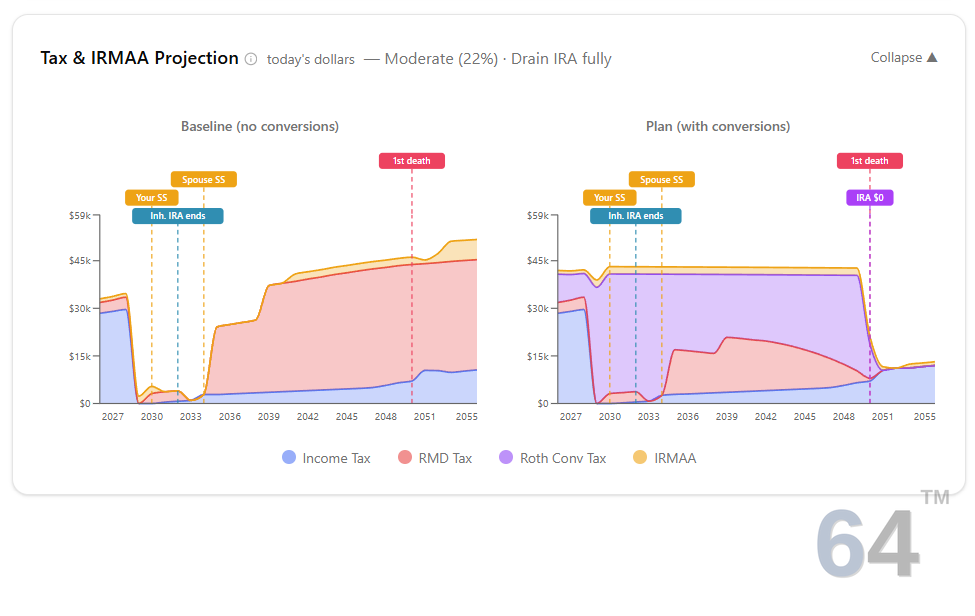
Without conversions (left), the Morrisons' tax climbs with their RMDs and keeps climbing after the first death. Moderate (right) pays its tax early, while both are alive, and the survivor's tax drops once the IRA is empty.
If both die early, converting more doesn't help much once heirs are taxed honestly. If the Morrisons both died at 80, Conservative would leave their children $3.82 million, Moderate $3.78 million and Aggressive $3.70 million.
So a more aggressive strategy is insurance for the spouse left behind. Lean that way if one of you is likely to be alone for many years, if your children are high earners, or if you expect tax rates to rise. Lean gentler if you want more cash on hand, if your heirs earn modest incomes, or if a charity gets the IRA.
Where You Fit
To see whether there's a pattern, I ran married couples from $200,000 to $10 million in pre-tax accounts through WhenIm64, each with two children earning $150,000. Wealthier households hold more in taxable accounts, because 401(k) limits cap the IRA but nothing caps savings outside it, so I scaled the taxable account up faster than the IRA. For a couple retiring around 65:
| Pre-tax IRA + 401(k) |
Usually recommended |
| Under $400,000 |
No conversion. The IRA usually gets spent, so there's little left to protect |
| $400,000 to $1 million, with savings outside less than about half the IRA |
No conversion. Paying the tax would mean dipping into the IRA itself |
| $400,000 to $1 million, with savings outside about as large as the IRA |
Conservative |
| $1 to 3 million |
Conservative to Moderate |
| $4 to 7 million |
Moderate to Aggressive |
| Over $7 million |
Aggressive to Maximum |
The bottom of the table is where conversions get skipped most, and where the 12% bracket is the best deal on offer. A couple with $600,000 in an IRA and $360,000 saved outside it finished with about $150,000 more for their children by converting to the top of the 12% bracket each year. The same couple with $150,000 saved outside couldn't pay the tax without tapping the IRA, and converting made no sense. Below about $400,000, a couple living on Social Security plus withdrawals usually draws the IRA down, and there's nothing left for a conversion to protect.
Conservative is also the strategy a lot of Roth advice describes without naming it: convert, but stay under the first IRMAA threshold so you never pay a Medicare surcharge. For most couples under $3 million, that's the one that won in my testing. Above that, the IRA is big enough that paying a surcharge for more room each year starts to pay off.
One caution if you retire before 65 on ACA coverage: a conversion counts as income and can cost you premium subsidies. WhenIm64 doesn't weigh that yet, so check before you convert.
From $1 million to about $7 million, the strategies usually finish within 1% to 2% of each other on net estate. So the size of the IRA doesn't settle it alone. Four things move you along the table:
- Your heirs' incomes. High earners move you up a level. Modest earners, or a charity, move you down.
- The size of your taxable account. It pays the conversion tax. A thin one holds you back.
- How many years you have left to convert. Couples who retire at 59 have a decade before Social Security and RMDs, so a gentle strategy usually gets there. A couple already at 70 has to push harder.
- Your health and your family. The survivor argument above.
Very few people sit at the top of this table. About 1 in 20 households has more than $1 million in retirement accounts (CRS, 2022 Survey of Consumer Finances), and balances over $5 million are rare (GAO). But if you're there, filling only the 22% or 24% bracket leaves millions in the IRA, and your children's shares will be taxed at 32% to 37% however many of them there are.
What about the "tax valley"? Every strategy here already converts the most in the years between retiring and Social Security, when your other income is lowest. I tested converting harder in those years and easing off once Social Security or RMDs began. It never beat simply picking one strategy and sticking with it.
Revisit It Every Year
None of this is a decision you make once. A conversion strategy is a best guess under today's tax law, with today's balances, for the family you have today. All three will change.
Rerun the comparison at least once a year, before you do that year's conversion, and start from your actual balances, not last year's projection. A good year in the market, a big expense or a conversion you've already made all move the numbers.
Look harder at the milestones: retiring, Medicare at 65, your first Social Security check and your first RMD. Each one changes your income, and with it the room under every tax bracket and IRMAA threshold. Meanwhile the current tax brackets were only made permanent in 2025, and Congress can change them again. Your children's careers change, families grow, a charity becomes important to you, one of you gets a diagnosis.
Any of those can move you to a different strategy, and changing is fine. Dropping from Moderate to Conservative one year and back the next is the plan doing its job. If something big changes partway through a year, rerun it before you convert the rest.
The WhenIm64 tagline is "Retirement isn't a spreadsheet. It's a journey." The strategy cards give you strong guidance for the conditions you're in today. Treat them as a place to come back to, not an answer to file away.
Try It With Your Own Numbers
I built WhenIm64's strategy cards because I couldn't find a tool that showed all of this side by side. Each card shows your lifetime tax, your heirs' tax, the net estate, the Roth at the end of the plan and your surviving spouse's RMDs, all in today's dollars. You tell it how many heirs you have, what they earn and how much of the IRA goes to charity, and it recommends from there.
Open the Morrisons' plan, compare the five strategies, then change the numbers to your own.
Who inherits your IRA, and what will they be earning when they do?
Ben Sprachman is the founder of WhenIm64.ai, a retirement planning tool for people navigating retirement. He is not a financial advisor or tax professional. This article is for educational purposes only. Consult a qualified tax advisor for guidance specific to your situation.