Medicare open enrollment starts October 15, and most people will spend it comparing drug plans. The bigger decision comes first: Medicare Advantage or Medigap. Choose Medicare Advantage, and in most states you may not be able to get a Medigap policy again. I made that choice quickly for my family, and I'd make it the same way today.
With Medicare Advantage, drug coverage comes bundled in the plan. With Medigap, you pick a separate Part D drug plan. I spent several weeks this fall inside the raw data Medicare publishes for 2027: every Medicare Advantage plan in every state, every stand-alone drug plan, and the Medigap rate charts. Here's what changed, and how to think about the first decision before you compare anything else.
What open enrollment does, and doesn't, cover
Open enrollment, October 15 to December 7, covers Medicare Advantage and Part D drug plans. Medigap is not part of it. What you can do depends on where you are now:
| You have |
You can |
You can't |
| Medigap, keeping it |
Change Part D plans |
Change Medigap carriers |
| Medigap |
Switch to Advantage |
Count on getting Medigap back |
| Advantage |
Switch plans, or go back to Original Medicare |
Count on getting Medigap |
If you're on Medicare Advantage, you get a second chance from January 1 to March 31: one switch to another Medicare Advantage plan, or back to Original Medicare.
Changing Medigap carriers runs on its own clock, and the rules depend on your state. In most states you can apply any time, but the new insurer can ask health questions and turn you down. A few states are more generous: New York and Connecticut guarantee acceptance year-round, and California gives you a window each year around your birthday. Check your own state's rules before you shop; your State Health Insurance Assistance Program (SHIP) can tell you for free. If you do switch, you get 30 days to keep both policies while you make sure the new one works.
Two paths
|
Advantage |
Medigap |
| How it works |
A private plan replaces Medicare |
Medicare pays, Medigap fills gaps |
| Premium |
Often $0 |
Medigap + Part D |
| Worst case |
Up to $9,850 |
Near zero |
| Doctors |
Plan network |
Any that take Medicare |
| Prior approval |
Common |
Rare |
| Drugs |
Usually included |
Separate Part D plan |
| Extras |
Dental, vision, hearing |
None |
| Switch later |
Medigap not guaranteed |
To Advantage, every fall |
Both paths also pay the Part B premium. Worst case is in-network medical costs for 2027.
The trade is simple to say and hard to price: Medicare Advantage costs less when you are healthy, and Medigap costs less when you are not.
Why I chose Medigap
I'll be upfront: I never tried Medicare Advantage. I looked at it just long enough to see it wasn't for my family.
We were already dealing with a chronic illness in the family that needed expensive medical care. I wanted to choose our doctors and hospitals without prior authorization standing between us and a treatment. And I wanted to travel without wondering whether we were covered.
The math backed that up. With the medical bills we were already running, we would have hit a Medicare Advantage out-of-pocket maximum every year. At that point a Medigap premium is the cheaper way to pay for the same care, and it comes without the networks and the paperwork.
The trade-offs were small. I had to buy separate dental insurance, which was inexpensive through the Massachusetts Health Connector, and eyeglasses aren't covered. I didn't see much value in the extras anyway.
Living in Massachusetts, I knew I could move to Medigap later if I changed my mind. It didn't matter. I would have made the same choice in any state.
That's my situation, not a rule. If you're healthy, rarely travel, and like the doctors in a local network, Medicare Advantage can be a perfectly good choice. Just go in knowing how hard it may be to come back.
What it costs: three health scenarios
To put numbers on that trade, I priced one Medicare Advantage plan against Medigap for 2027 in Massachusetts, with the same brand on both sides: UnitedHealthcare's AARP Medicare Advantage MA-0006 (PPO) against an AARP Supplement 1A policy plus my own drug plan, Humana Basic Rx.
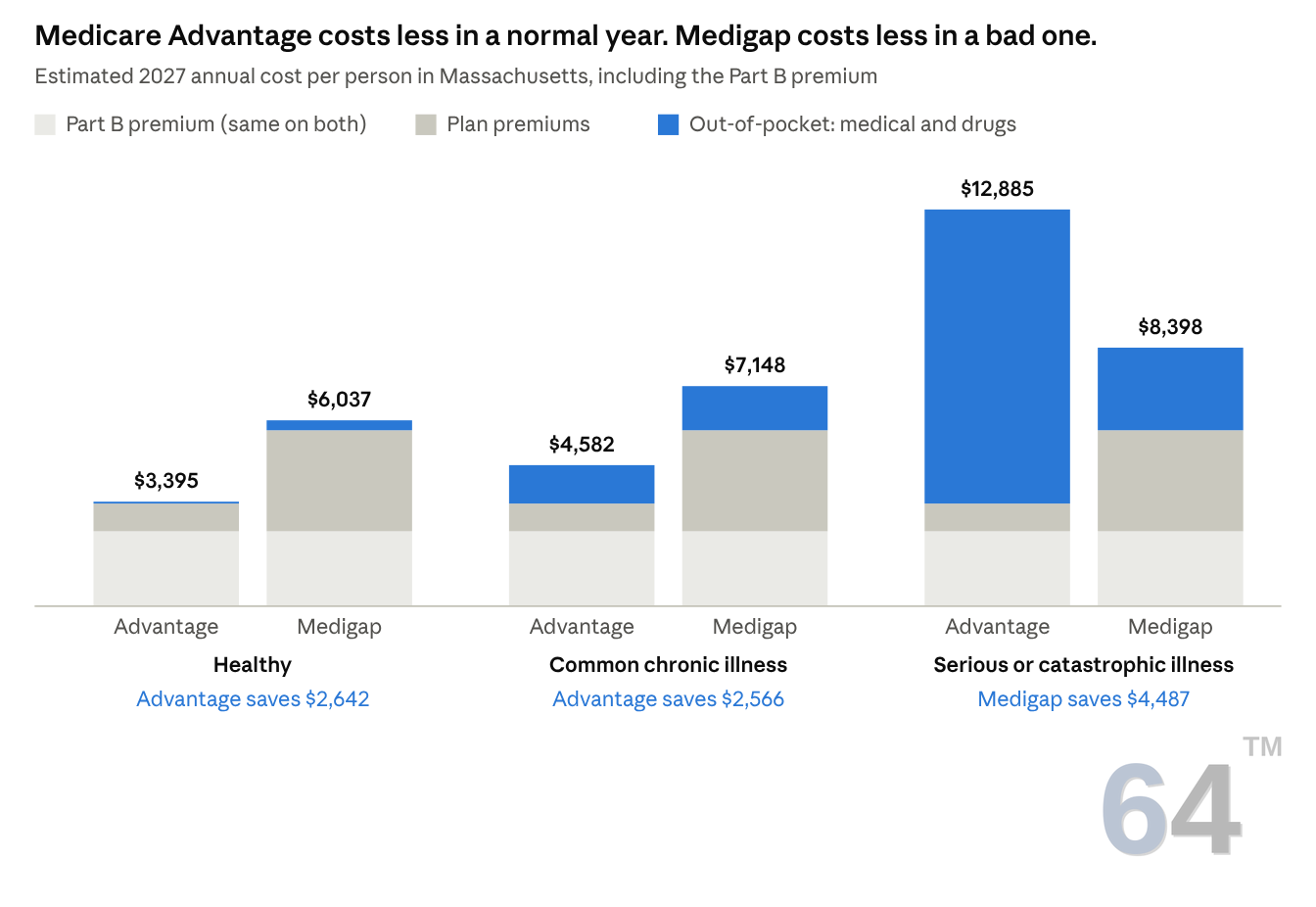
In a healthy year, or with a chronic condition like diabetes that's well managed with drugs, Medicare Advantage saves about $2,600. In a year of serious illness it costs about $4,500 more, because the plan's $7,150 out-of-pocket limit replaces Medigap's near-zero cost sharing. A 60-day hospital stay or bypass surgery doesn't make it worse: both paths are capped. Drug costs come out nearly the same either way.
How these were estimated: 2027 premiums, out-of-pocket limits and drug deductibles from Medicare's plan data. Medical copays are the plan's 2026 rates, since 2027's aren't published yet. Medigap and Part B use 2026 rates. Drugs are priced at the plans' negotiated prices. Dental, vision, IRMAA and out-of-network care are not included.
The real risk: a bad year that becomes a bad decade
The chart shows one year. The bigger risk is what comes after. If you or your spouse develops a serious chronic illness, or has a debilitating accident, while on Medicare Advantage, that bad year can repeat every year. In most states you can't fix it by switching: Medigap insurers can ask about your health and turn you down. You're left paying about $4,500 a year more than Medigap would cost, for the rest of your life. Over ten years that's roughly $45,000, before inflation.
That's how I think about Medigap: insurance on top of insurance. Medicare Advantage limits what one bad year can cost. Medigap also protects you from a bad decade, and it keeps your choice of doctors and hospitals when the stakes are highest.
What the chart doesn't show
- Getting care approved. Medicare Advantage plans require prior authorization for most major procedures, including bypass surgery, joint replacement and the rehab that follows. In 2024 they denied 4.1 million of 53 million requests (7.7%), according to KFF. Only 11.5% of denials were appealed, and 80.7% of those appeals won. Original Medicare rarely requires approval.
- Where you get major surgery. On an HMO, out-of-network care generally isn't covered except in emergencies. A PPO covers it at higher cost, up to a combined limit as high as $14,800. Medigap works at any hospital in the country that takes Medicare.
- An illness that spans two years. Surgery in November and recovery in January can mean hitting the Medicare Advantage limit twice.
- Long-term care. If a serious illness leads to needing help with daily living, none of these pay: not Medicare Advantage, not Medigap, not Original Medicare. WhenIm64's long-term care planning walks through the options.
What changed for Medicare Advantage in 2027
The maximum in-network out-of-pocket limit rises to $9,850, and the combined in- and out-of-network limit for PPO plans to $14,800. Those are the ceilings; many plans set lower limits.
There are fewer plans to choose from: about 3,800 nationally for 2027, down 7% from 2026.
Don't judge Medicare Advantage by the TV ads. They are national, but the plans are local. In Florida, 94% of plans have a $0 premium. In Massachusetts, nearly two-thirds charge one, and the biggest carriers are regional names you won't see in a national ad. Look only at the plans offered in your county.
Star ratings for 2027 plans come out in October. Check them before you choose.
Drug coverage shouldn't drive this decision
The $2,400 annual cap on covered drug costs applies the same way inside a Medicare Advantage plan as in a stand-alone Part D plan. Since the Inflation Reduction Act, neither path can leave you with an unlimited drug bill, so drugs are not a reason to pick one path over the other.
Drugs still matter once you are choosing a specific plan. Check that the plan's formulary covers what you take and that your pharmacy is in its network. And remember that switching Medicare Advantage plans also switches your drug plan, with all the pharmacy hassle that comes with it.
What changed for Medigap
Medigap works differently from everything above. There is no plan year. Your premium changes when your carrier files a rate increase, often on your policy's anniversary, and each carrier runs on its own schedule. In Massachusetts, most carriers reprice on January 1, but two of them last changed rates in June 2025.
Carriers are also leaving. Humana stopped selling Medigap to new customers in Massachusetts as of April 1, 2026. If you already have a Humana policy, it keeps renewing, but over time you are in a closed pool of aging policyholders, which tends to push rates up. Watch your renewal notices.
The one-way door: leaving Medicare Advantage for Medigap
Open enrollment lets you leave a Medicare Advantage plan for Original Medicare. What it does not do is guarantee you a Medigap policy. Outside your first Medigap enrollment window, insurers in most states can ask health questions and turn you down or charge more. KFF, the independent health policy research group, found that 90% of Medicare Advantage enrollees have no guaranteed right to buy Medigap after their first year.
A handful of states, including New York, Connecticut and Massachusetts, let you buy Medigap at any time regardless of your health. If you joined Medicare Advantage within the past 12 months when you were first eligible, you may also have a one-time "trial right" to switch back. Otherwise, get a Medigap acceptance in writing before you drop Medicare Advantage, and ask your SHIP how your state's rules work.
My open enrollment checklist
- Decide the path first: Medicare Advantage or Original Medicare with Medigap.
- On Medicare Advantage, compare plans in your county on worst-case cost (premium plus the out-of-pocket limit), star ratings, and whether your doctors and hospitals are in network for 2027.
- Do not leave Medicare Advantage for Medigap without a written acceptance, unless your state guarantees it.
- On Medigap, your next decision is your Part D plan. See Open Enrollment Starts October 15: Don't Let Your Drug Plan Auto-Renew.
- Mark December 7 on the calendar. Changes take effect January 1.
WhenIm64 compares Medicare Advantage carriers in your state and Medigap options side by side, using Medicare's own 2027 data.
Ben Sprachman is the founder of WhenIm64.ai, a retirement planning tool for people navigating retirement. He is not a financial advisor or insurance broker. This article is for educational purposes only.