My drug plan's premium is going from $8.40 a month to $26.10 in January. If I do nothing between October 15 and December 7, that's what I'll pay, because Medicare renews you automatically. Yours probably changed too. Every national drug plan now has a deductible, and UnitedHealthcare's AARP Saver plan is up 90% on average.
If you're on Original Medicare with a Medigap supplement, open enrollment is about one thing for you: your Part D drug plan. Changing Medigap carriers runs on a separate, state-specific clock. If you haven't settled the bigger choice yet, start with Medicare Open Enrollment Starts October 15: Make the Decision That's Hard to Undo First.
While updating WhenIm64 for 2027, I went through every national stand-alone drug plan and the drug prices those plans actually pay. Here's what changed, and what I'd do about it.
Part D: a higher cap, and a deductible on nearly everything
Two numbers set the shape of every drug plan in 2027:
- The annual out-of-pocket cap rises to $2,400 (from $2,100 in 2026). Once your covered drug costs reach it, you pay nothing more for the rest of the year.
- The maximum standard deductible rises to $700 (from $615).
The bigger change is in the plans themselves. For 2027, every national stand-alone drug plan I looked at has a deductible. The "no deductible" mid-priced plans that made sense for people on brand-name drugs have essentially disappeared from the national carriers. The lowest deductibles left are on the expensive enhanced plans, around $300 to $350.
Carriers moved too. Aetna's SilverScript Choice pulled out of 13 of its 33 regions. Where it remains, in 22 states and Washington, D.C., it costs $86 to $167 a month, up from as little as $15 this year. And premiums for the same plan shifted a lot from one year to the next, as mine did.
Same drugs, one year later, a different winner
To see how much changes, I ran the same list of seven relatively inexpensive generic drugs through WhenIm64's plan comparison for both years, filled by mail order in Massachusetts. Here is 2027:
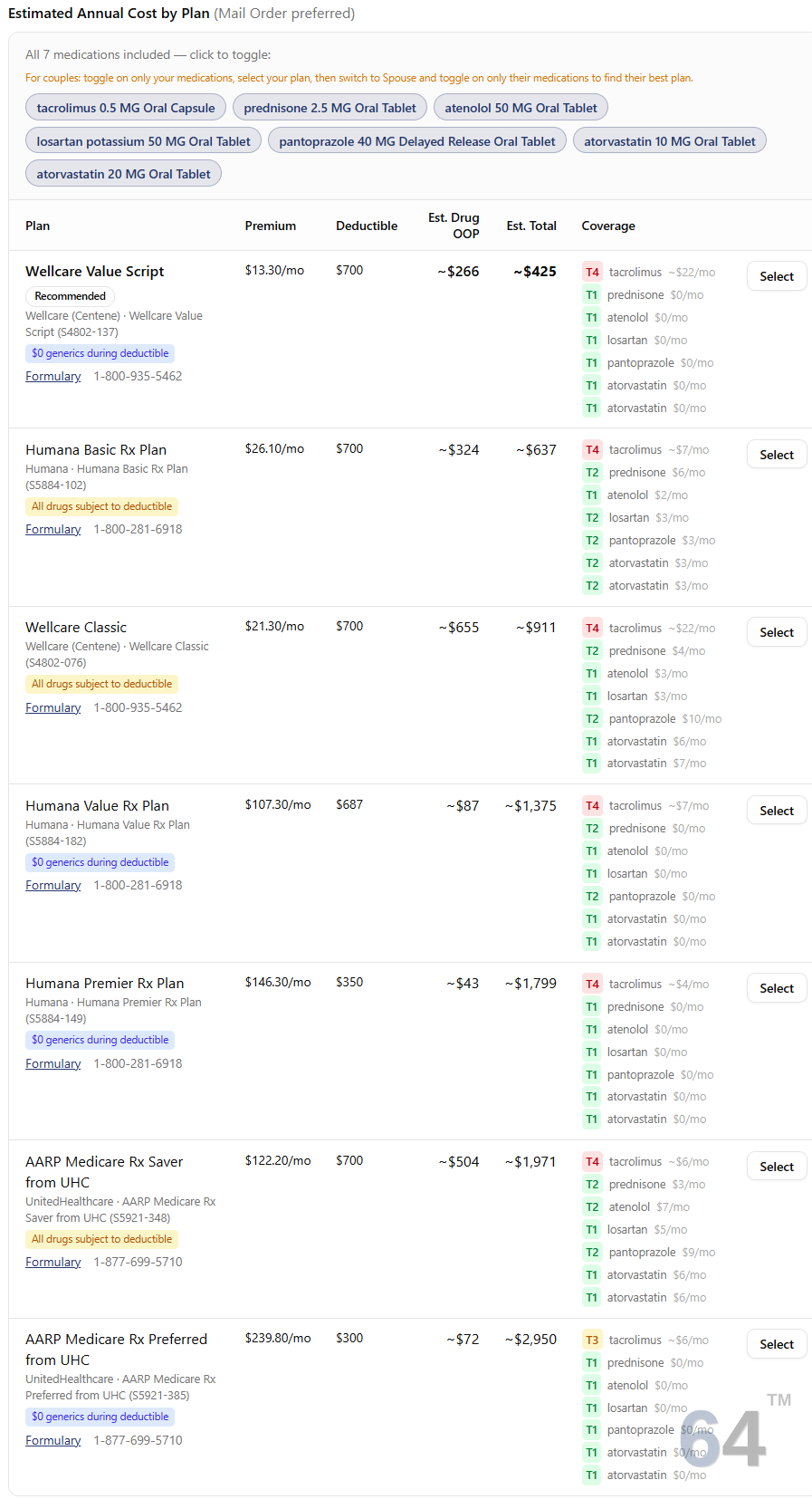
WhenIm64's 2027 plan comparison for this drug list. 2027 drug coverage is preliminary until Medicare publishes the 2027 formularies.
In 2026 the cheapest plan for these drugs was Humana Basic Rx, at about $425 for the year. In 2027 the cheapest total is the same $425, but from a different plan: Wellcare Value Script. Humana Basic now costs about $637, so doing nothing costs $212. The two premium plans still cut drug costs to under $75 a year, but charge $1,750 to $2,900 in premiums to do it. And Aetna's SilverScript, in the middle of the pack in 2026, isn't offered in Massachusetts next year.
We've already gone around this circle once. In 2025 I was on Wellcare Value Script and my wife was on Humana Value Rx. For 2026 we both moved to Humana Basic Rx, the cheapest plan for our drugs that year. Now, for 2027, the cheapest plan for our list is Wellcare Value Script again.
It's cheap partly by design. Wellcare keeps Value Script separate from the plan Medicare uses to auto-enroll people who get Extra Help with drug costs, so it mostly attracts people like us who take generics, and it can price accordingly. That's a good deal if you fit the profile. Just don't expect any plan to stay the cheapest for long.
So re-run the comparison every fall. WhenIm64 keeps your drug list, so during open enrollment comparing next year with this year is one click: switch the plan year and the plans re-rank.
The cap fixed expensive drugs. The expensive plans didn't.
Going through plans last year, one thing jumped out at me. Many of the most expensive drug plans offered essentially no value.
Before 2025, a plan with a high premium and low copays was insurance against a catastrophic drug year. The Inflation Reduction Act of 2022 changed that. It capped what you pay for covered drugs on every plan, including the cheapest: $2,100 this year and $2,400 in 2027. The law fixed the problem those plans were built to solve.
Do the math and the expensive plans fall apart. Your worst case on any plan is its premium plus $2,400. In Maine and New Hampshire, Wellcare Classic costs $88 a year in premiums for 2027. UnitedHealthcare's AARP Medicare Rx Preferred costs $2,110. If you take a specialty drug, you hit the cap on either plan, and the expensive one just costs you $2,000 more. If you take a few generics, the expensive one still costs you $2,000 more.
I expected the carriers to adjust for 2027. Instead, a federal subsidy that had been holding premiums down ended, and prices went up across the board. UnitedHealthcare's AARP plans rose 62% to 90% on average. In 21 of Medicare's 34 drug-plan regions, a UnitedHealthcare AARP plan now charges more in premium alone than the $2,400 most you could ever pay for covered drugs.
The good news is that the stakes are much lower than they used to be. As I wrote in Why Is Choosing a Medicare Part D Plan So Complicated?, you are no longer buying protection from a disaster. The cap already gives you that. You are looking for the lowest total cost for the drugs you actually take.
The deductible trap, and why premium is the wrong number
Earlier this year I wrote that I had picked the wrong Part D plan. When I went back and ran my drugs through the actual prices Medicare publishes, the answer turned out to be the opposite: my low-premium plan was the right choice for my drugs, and the plan that looked better had been compared using the wrong premiums.
The lesson is the same either way. Premium is the most visible number, but the only number that matters is your estimated annual total: premium plus what you will pay for your drugs over the year.
The part almost nobody explains is what happens during the deductible. Until you meet it, you pay the plan's negotiated price for the drug, not the copay. If your drugs are cheap generics, you may never meet a $700 deductible at all, and you will pay full price every month. That sounds bad, but for generics the full price is often only a few dollars a month. For me, paying full price for four generics all year cost far less than the extra premium of a plan that waives the deductible.
It flips for brand-name drugs. If you take one or two drugs that cost hundreds a month, you will blow through the deductible early, and a plan with lower copays afterward can win despite a higher premium. And if you take a specialty drug that costs thousands a month, you will hit the $2,400 cap on your first fill. At that point every plan costs you the same in drugs, and the lowest premium wins, as long as the plan covers your drug.
What to do: enter your own drug list, with the right doses, and your pharmacy. Without it, any comparison is really just a comparison of premiums. Your true cost depends on which tier each plan puts your drugs on and what it charges for them during the deductible, and that is different for every plan. WhenIm64 saves your drug list and prices it against every plan in your area using Medicare's own formulary, pricing and cost-sharing data, so the ranking reflects what you would actually pay. Mail order is often cheapest for maintenance drugs. The Medicare Plan Finder at medicare.gov can do this too, as long as you enter your drugs and compare the estimated annual cost, not the premium.
The hidden cost of switching
When I moved from Wellcare to Humana for 2026, I changed plans on the Medicare site and assumed my prescriptions would follow. Some did. Some didn't. My wife's switch, from one Humana plan to another, was painless.
The difference was the insurer. Each one has its own mail-order pharmacy: CenterWell for Humana, Optum for UnitedHealthcare, CVS Caremark for Aetna, Express Scripts for Wellcare. A new insurer meant new prescriptions from my doctor. Prescriptions with no refills left, controlled substances, and any prior approvals or formulary exceptions all start over too. The new plan has to give you a one-time temporary supply of a drug you already take, but after that you need its own approval.
My personal rule: if a different insurer saves me less than about $100 a year, I don't bother. If you take a specialty drug or have won an exception, the bar is much higher. If you do switch, refill your maintenance drugs in mid-December, a 90-day supply if you can, so a stuck prescription in January doesn't leave you without medication.
So will we switch back to Wellcare? I haven't decided, and I'm giving myself until December 7. My wife just went through a long approval with Humana for a specialty drug, and I'm not sure $212 a year is worth risking that process again with a new insurer. I may well keep the more expensive plan for that reason alone.
That's the real point. Whatever you choose, make it a conscious decision before December 7, not a default. Everyone's situation is different, which is why you need to run your own numbers, in WhenIm64 or on Medicare's Plan Finder, and then weigh what the numbers can't show you.
Insulin is capped at $35 a month
If you use insulin, Medicare caps your cost at $35 for a month's supply on covered insulins, and the deductible does not apply. Some plans charge less. Under this rule, insulin should not be the reason to pick a more expensive plan, so focus the comparison on your other drugs.
When your drug is not on the formulary
This one is personal. A family member was recently prescribed a newly approved specialty drug that no major national drug plan covers. Their $8-a-month plan approved it anyway, through what is called a formulary exception, and its cost counts toward the $2,400 cap. A more expensive plan would not have helped: every plan, at every price, has the same exception process. How that process works, and what the doctor has to show, deserves its own article, and I'll write it next.
If you are in this situation, two things matter at open enrollment:
- Ask your plan whether the exception continues into 2027. Approvals usually last for the plan year, and renewal isn't guaranteed.
- Spread the cost. With a very expensive drug you will hit the cap on your first fill. The Medicare Prescription Payment Plan, which every Part D plan must offer, turns that into monthly bills. It spreads the cost over the months left in the calendar year, so it helps most when you start in January; start in November and you get two big bills instead of one.
My open enrollment checklist
- Re-run your Part D comparison with your current drug list and pharmacy. Compare total annual cost, not premium, and weigh the hassle if the cheaper plan is from a different insurer.
- If you take a new or specialty drug, confirm 2027 coverage first, then compare premiums.
- Check your plan's 2027 changes notice, which you should have recently received.
- Make a conscious decision by December 7: stay or switch. Doing nothing renews your plan at next year's price. Changes take effect January 1.
WhenIm64 compares 2027 drug plans on estimated total annual cost for your drugs, using Medicare's own pricing and cost-sharing data. Some 2027 drug-coverage details are preliminary until Medicare publishes the final 2027 formularies, and we will update as soon as it does.
Ben Sprachman is the founder of WhenIm64.ai, a retirement planning tool for people navigating retirement. He is not a financial advisor or insurance broker. This article is for educational purposes only.