After I retired, my Social Security estimate went down. Not by much, less than 1%, but I hadn't claimed yet, and I'd assumed the number on my statement was the number I would get. It isn't. It's a projection, and it rests on an assumption that stopped being true the day I stopped working.
Your Social Security statement is six pages of dense text, most of it about special cases. For a retirement plan you need one number from it, and two things about that number: what it assumes, and what it leaves out.
The One Number
Page 1 has a chart of monthly estimates, one bar for each age you could start, from 62 to 70. You need the last one.
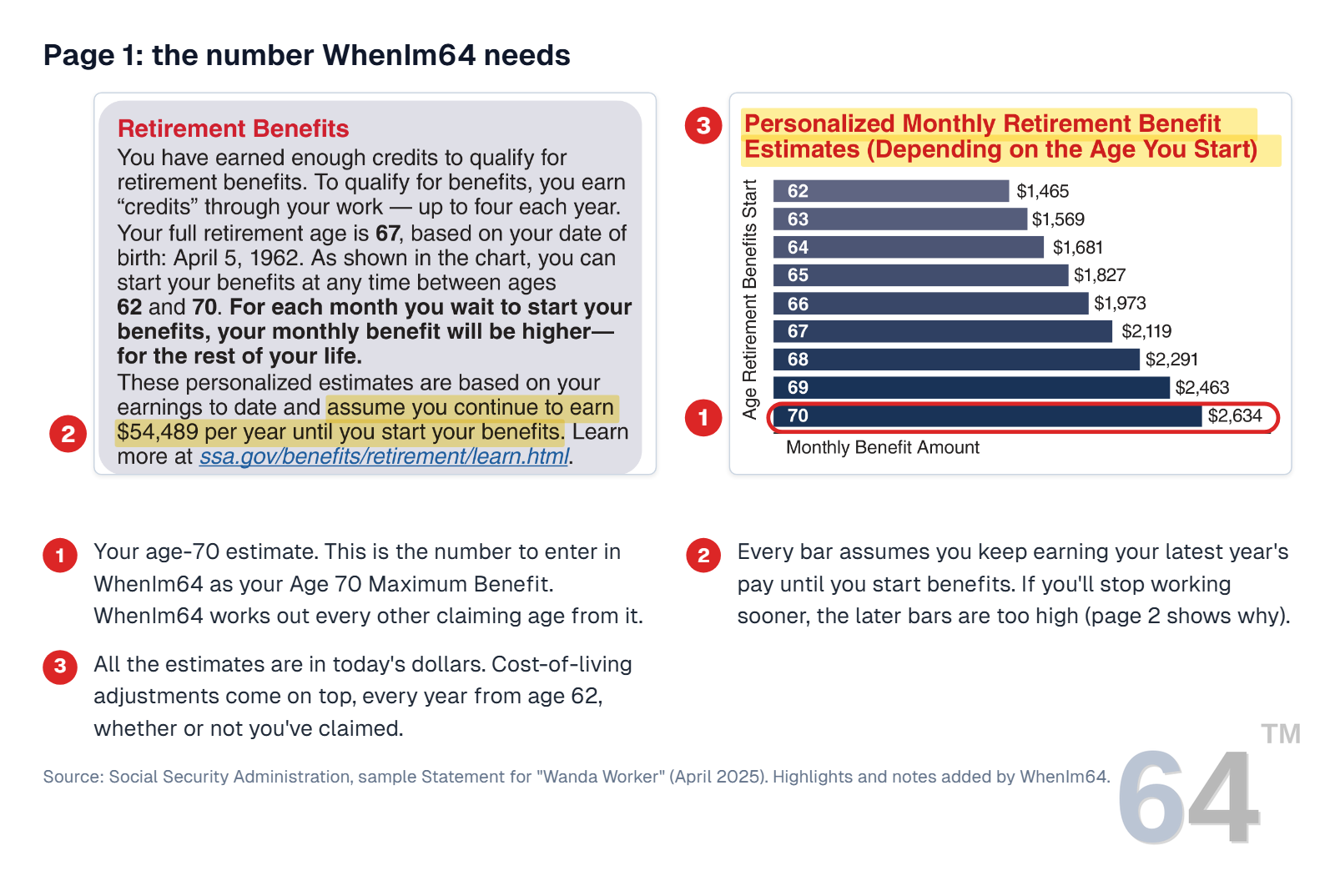
WhenIm64 asks for your age-70 estimate, the "Age 70 Maximum Benefit". From it, it works out your benefit at full retirement age and at every age you might claim, using the same percentages Social Security uses. Starting from the top bar keeps every claiming age open, so the plan can compare them instead of locking one in.
If you're married, your spouse does the same from their own statement. If one of you has no work record of your own, enter 0. WhenIm64 applies the spousal benefit, up to half of the other spouse's full benefit, and after the first death the survivor keeps the larger of the two checks.
If you're already collecting, the chart doesn't apply to you. Enter your current monthly benefit instead: the full amount before the Medicare premium is taken out, not the deposit in your bank account. Your yearly cost-of-living notice and your my Social Security account both show it.
The Assumption Behind Every Bar
Next to the chart, the statement says what every estimate assumes: that you keep earning what you earned last year until you start your benefits. For the age-70 bar, that means working until 70.
If you've already stopped, or will stop well before you claim, the years of zero earnings aren't on your record yet. When they post, the estimate drops. That's what happened to mine.
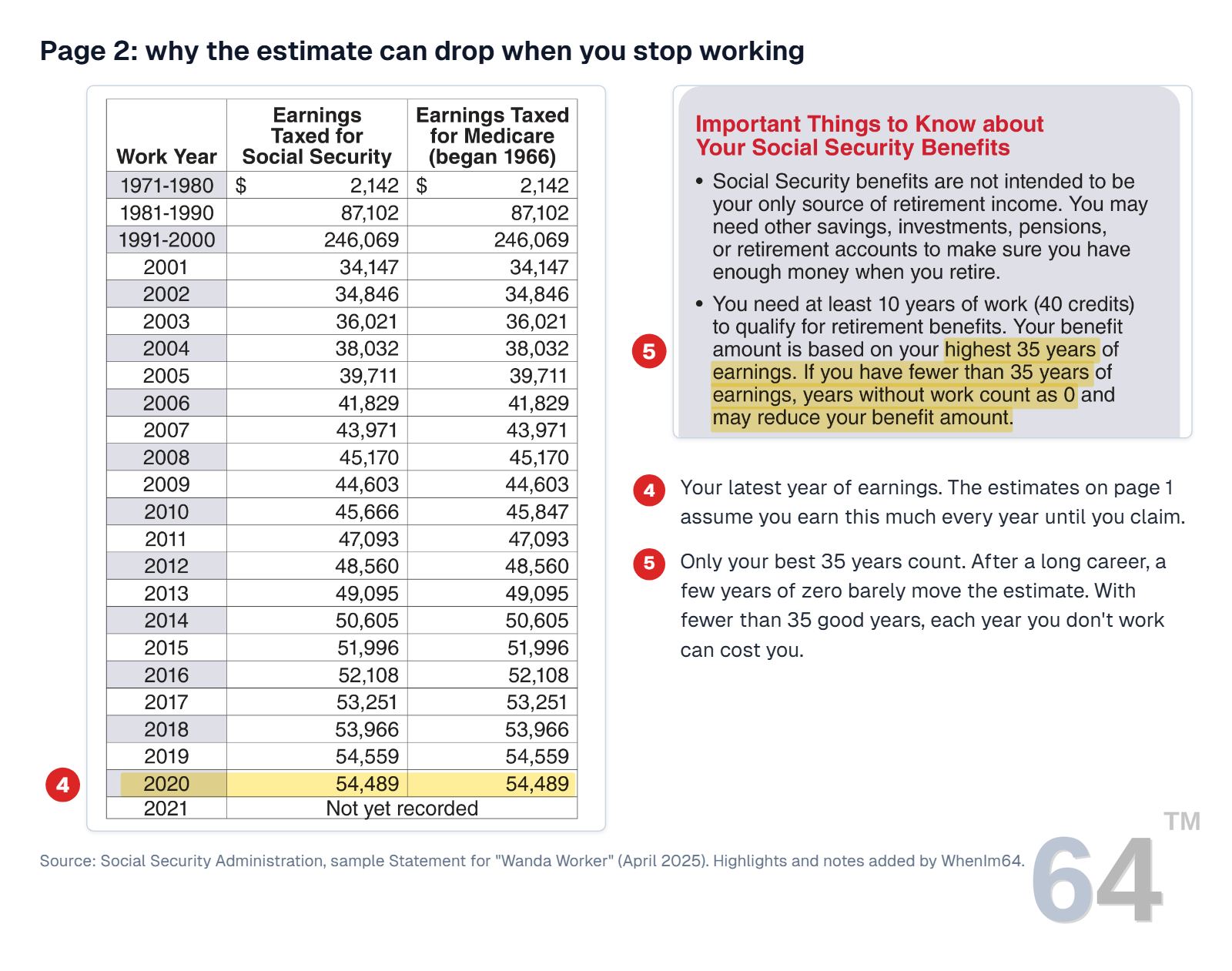
How much it drops depends on your earnings record. Your benefit is based on your highest 35 years of earnings, with years before 60 adjusted for wage growth. Extra years count only if they beat one of your 35.
Take a hypothetical worker born in 1964 who has earned at least the Social Security maximum since the mid-1980s and stops working at 62, in 2026. His statement assumes he keeps earning $176,100 a year until 70. Because he's not going to, his age-70 benefit will be about $5,230 a month in today's dollars, not the $5,260 the statement shows. That's $30 a month, about 0.6%. He already has 35 strong years, so more work would only have replaced slightly smaller ones.
A shorter record works the other way. Someone with 30 years of earnings averaging $60,000 in today's wages who stops five years before claiming gets about 10% less than the statement shows, because five zeros now count among their 35 years.
If that's you, use the Retirement Calculator in your my Social Security account. Set the date you plan to stop working, and use its age-70 estimate instead of the statement's. WhenIm64 also warns you when your plan has you stopping work more than two years before you claim.
Today's Dollars, Plus COLAs
The estimates are in today's dollars. Don't add cost-of-living adjustments (COLAs) yourself; WhenIm64 does it.
The COLAs start at 62, even if you haven't claimed. So if you're past 62, your statement already includes the COLAs since then, but none of the future ones. WhenIm64 adds those: the 3.6% COLA announced in October for 2027, then your plan's inflation rate for each year after that, through the year you claim and every year you collect.
Update the number once a year, when your new statement posts. If you're still working, it may go up. If you've stopped, it may go down a little the first year or two. Either way, the plan should start from the latest one.
Why I Built It This Way
I built WhenIm64 to ask for one number because the statement's nine bars are really one benefit seen at nine ages, and each comes with the same assumption about work. Starting from age 70 lets the plan run every claiming age through your taxes, Roth conversions and survivor years, which is where the real decision is. I wrote about that in An Even Better Reason to Wait Before Claiming Social Security.
You can see how it works in WhenIm64's demo, which runs the numbers for a couple in Austin, Texas. To build a plan from your own statement, create a WhenIm64 account.
My estimate won't drop again. With no more earnings to project, it moves only with COLAs now.
Ben Sprachman is the founder of WhenIm64.ai, a retirement planning tool for people navigating retirement. He is not a financial advisor or tax professional. This article is for educational purposes only. Consult a qualified tax advisor for guidance specific to your situation.