After I finished How to Choose a Roth Conversion Strategy, I kept coming back to its main point. The question isn't how much tax you pay. It's who pays it: you, at your rates now, or your children, at theirs, within 10 years of inheriting your IRA.
Then I went back to the question everyone asks about Social Security: when should you claim? The usual reason to wait until 70 is the bigger check, and it's a good one. It does most of the work. But running the whole plan with the children's tax in it turned up a reason I like even better, because it lands on the people you're planning for: waiting gives you the years to empty the IRA, so your children never pay that tax.
The Tax Valley
When you retire before Social Security begins, your taxable income drops sharply. No more W-2. SS not yet started. If you haven't hit RMD age, your IRA sits untouched. For many retirees this opens a window, sometimes several years wide, where taxable income is at its lowest point in the plan.
In 2026 a married couple can recognize about $133,000 of income at 12% or below: the $100,800 top of the 12% bracket plus the $32,200 standard deduction. Once you're both 65 it's closer to $148,000, with the extra age-65 deduction and the $6,000-a-person senior deduction that runs through 2028.
Claim Social Security early and the checks fill that space. Delay, and every year until 70 is room for Roth conversions. (I first wrote about the valley in The Hidden Benefit of Delaying Social Security.)
The Bigger Check Does Most of the Work
A quick estimate counts the extra bracket space delaying creates and prices it at 12%. The full plan prices everything: the conversions, the tax on the bigger check, RMDs, IRMAA, the survivor years and the tax your heirs pay on whatever IRA is left.
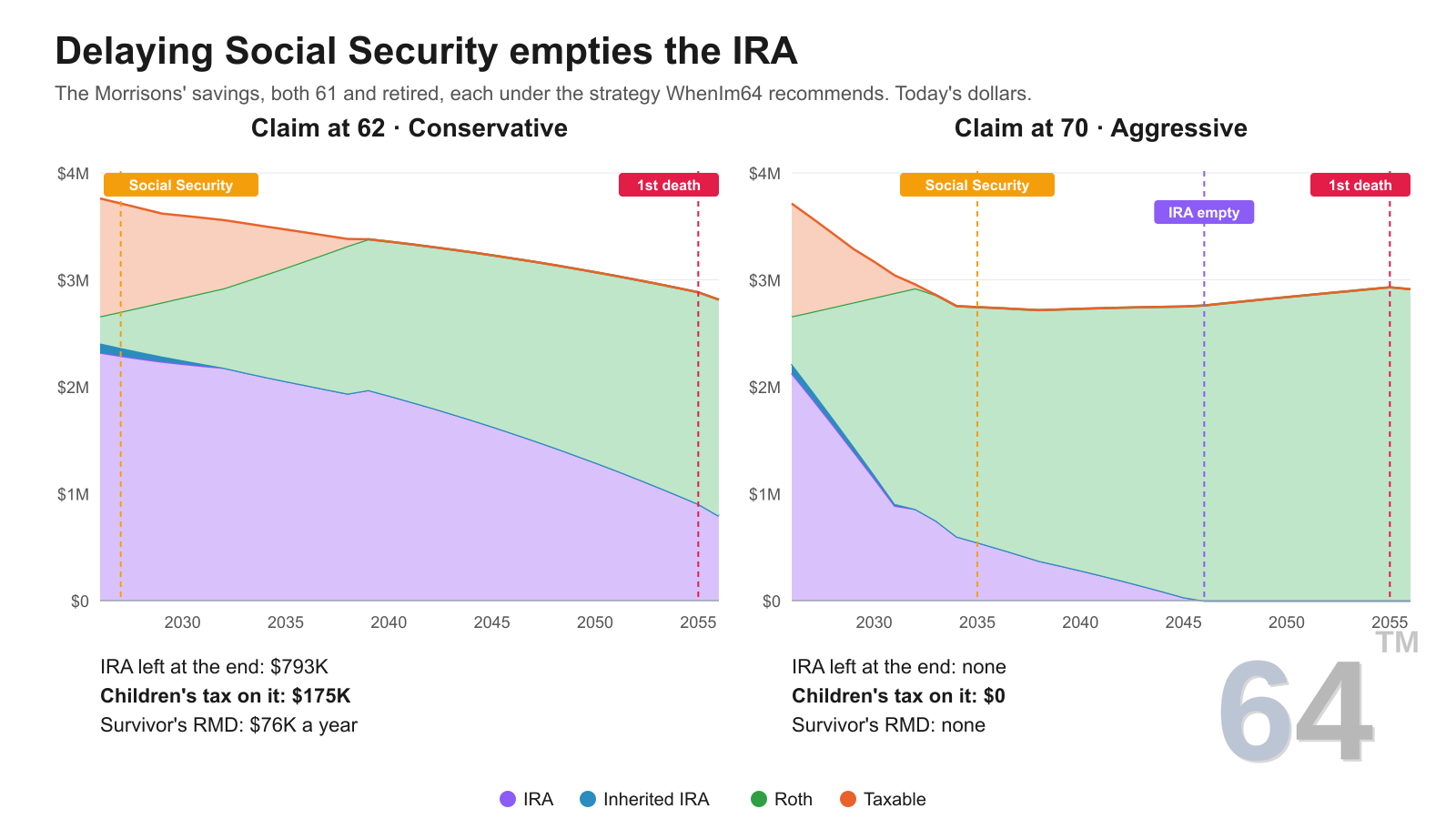
Take a couple with the Morrisons' savings, the demo household in WhenIm64: $2.3 million in IRAs and $1.2 million in a taxable account. Make them both 61 and retired. Claiming at 70 instead of 62 leaves their children about $272,000 more, in today's dollars. About $196,000 of that is the bigger check alone. Run both plans with no conversions at all and that gap is still there.
So yes, the check does most of the work. The other $76,000 is the even better reason.
The Even Better Reason: an Empty IRA
The Roth article's scoreboard is the net estate, not your own tax bill. Under the SECURE Act, most children must empty an inherited IRA within 10 years, usually while they're at the peak of their own careers. Every dollar left in your IRA gets taxed at their rate, on top of their salary. A Roth passes tax-free.
That's what the valley is for: moving the tax off your children and onto you, at lower rates.
WhenIm64 compares five conversion plans, from converting nothing to converting right up to the top Medicare surcharge threshold every year. The Roth article walks through them. Claiming at 62, the best is the gentlest: convert up to the top of the 12% bracket each year, about $700,000 before 70. The IRA never empties. A harder plan could empty it, but the gentlest one that does would leave their children about $45,000 less. With a smaller Social Security check, their RMDs later are taxed lightly, so paying the tax early mostly gives up the growth on that money. So their children pay about $175,000 of tax to inherit what's left. If one spouse dies, the survivor files single, with half-width brackets, and faces RMDs of about $76,000 a year.
Claiming at 70 changes the math. With no Social Security until 2035, they can convert much more. WhenIm64 caps each plan at a Medicare surcharge (IRMAA) threshold at every age, even before Medicare, so the harder plan converts up to the second threshold: about $285,000 a year, $1.75 million in all. That means real checks to the IRS, about $58,000 a year in federal income tax, in today's dollars, paid from their taxable account. Keeping the IRA isn't cheap either. Its RMDs, about $65,000 a year, would land on top of $92,000 a year of Social Security, most of it taxable. Still, the harder plan costs more: about $742,000 in lifetime tax against $711,000 for the gentle one, and about $28,000 less for their children, around 1%. For that, the IRA is empty by the time they're 81, their children owe nothing on it, and a survivor has no RMDs at all. WhenIm64 treats plans within 1% of each other as a tie and picks the one that leaves a survivor the smallest RMD, so it recommends the harder plan. That's the insurance argument from the Roth article. Compared with claiming at 62, they pay about $78,000 more tax themselves, and their children end up $272,000 ahead.