When you leave a job, your 401(k) has four places to go. You can roll it into your new employer's plan, roll it into an IRA, leave it where it is, or cash it out. Over 45 years and eight employer plans, I've done three of the four.
I also owe you a correction. In Is Rolling Your 401(k) to an IRA Always a Good Idea? I said I rolled my Prime Computer 401(k) into an IRA when I left in 1992. Going back through my records, that's not what happened. I rolled it into LSI Logic's plan, and for the next eight years my 401(k) followed my job. I don't remember even considering an IRA. Rolling into the next plan was just what you did.
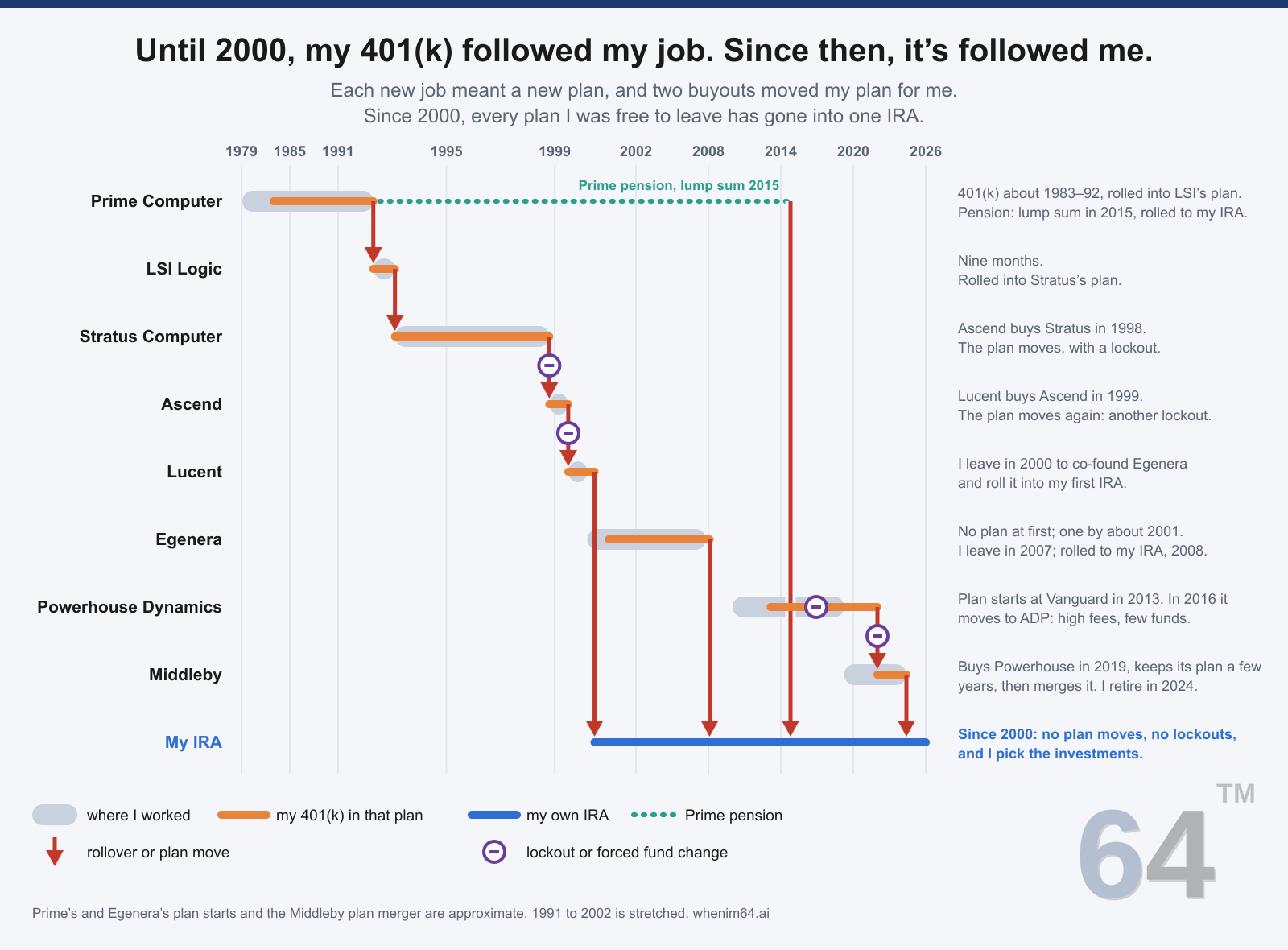
Each gray bar is a job. Each orange bar is my 401(k) in that company's plan, and each red arrow is a move. Some of those moves I chose. The ones with a purple marker, I didn't. The blue line is my IRA, and the teal dots are my Prime pension, which waited 23 years for me.
1. Roll It Into Your New Employer's Plan
This is what I did from 1992 to 1999, from Prime to LSI to Stratus. It's also what many in the FIRE crowd (financial independence, retire early) recommend today, and they have good reasons. Money in a 401(k) doesn't block the backdoor Roth, and everything stays in one account.
The catch is that you take whatever plan comes with the job, and whatever happens to it. Ascend Communications bought Stratus in 1998, and my 401(k) moved into Ascend's plan. Lucent bought Ascend in 1999, and it moved again. Each move came with a lockout, a stretch when I couldn't change investments or take money out. I didn't get a say. While you still work for the company, a plan merger isn't one of the events that lets you take your money out.
The worst plan I had came much later, at Powerhouse Dynamics. Its first plan started at Vanguard in 2013. In 2016 the company moved it to ADP: high fees and a short list of funds, mostly target-date funds. When a plan changes providers, it maps each old fund to a new one, and you don't get a say in the mapping. One of my funds landed somewhere I wouldn't have picked, and it was months before I could get at that money. A big market move went by while I couldn't do anything, and it cost me. Middleby bought Powerhouse in 2019, kept its plan for a few years and then merged it into its own. I couldn't leave any of it while I worked there.
2. Roll It Into an IRA
I opened my first IRA in 2000, when I left Lucent to co-found Egenera. I was one of three founders, and we didn't have a 401(k) until about a year later, so there was nothing to roll into. The Lucent money went into an IRA at Fidelity. Since then, every plan I was free to leave has gone there: Egenera's in 2008, my Prime pension in 2015 and Middleby's when I retired in 2024.
I wanted my money where I could buy individual stocks and ETFs at low cost, and none of those plans let me. Since 2000, my IRA hasn't moved unless I moved it. Near retirement, an IRA also makes Roth conversions, charitable distributions and required distributions easier, which I covered in the first article.
It isn't free. An IRA blocks the backdoor Roth.
What the IRA Cost Me
The backdoor Roth opened in 2010, when Congress dropped the income limit on Roth conversions. From then until I retired, my income was too high to contribute to a Roth IRA directly, and none of my employers offered a Roth 401(k), which has no income limit. The backdoor was the only way in. But the IRS looks at all your pre-tax IRA money on December 31, and a big rollover IRA makes most of each backdoor conversion taxable.
Here's roughly what that's worth. Someone over 50 who made a backdoor contribution every year from 2010 through 2024 would have put in about $100,500. That money would have been invested anyway, so the loss isn't the balance. It's the tax on the growth. At 7% a year, the Roth would be worth about $189,000 today. The same money in a taxable account, after federal and state tax on the dividends and gains, would be worth about $166,000. That's a difference of about $22,000, and it grows the longer the money stays invested, to about $73,000 by 2036.
Keeping the backdoor open would have meant moving my IRA into an employer plan. From 2016, that meant the ADP plan. On a $500,000 balance, an extra 1% in fees costs $5,000 a year. Four or five years of that and the backdoor would have cost more than it saved.
What I didn't know is that the other half was open all along. The pro-rata rule counts each person's IRAs separately. My wife didn't work, but on a joint return a spouse with no earnings can still contribute to an IRA, based on the other spouse's income. She had no IRA of her own, and an inherited IRA doesn't count, so her backdoor Roth was available every year. I never used it. If you're married, check each of you separately.
If your new employer's plan is good and accepts rollovers, there's a middle path: roll your IRA into it when you want to do a backdoor Roth, and out again when you leave. That's a choice you make with the plan in front of you.
3. Leave It With Your Old Employer
If your balance is over $7,000, the plan has to let you leave it there. I only did that for a few months at a time, after Lucent and after Egenera. My pension didn't have a choice. It stayed behind for 23 years, through Prime's renaming as Computervision and its sale to PTC, until PTC, a company I never worked for, closed the plan and offered a lump sum in 2015. I rolled it into my IRA. I could have rolled it into the Powerhouse 401(k) instead, since most plans accept rollovers. Five months later it would have been in the ADP plan.
Money you leave behind stays in the plan, and the plan stays with whoever sponsors it, not with you or your old division. Someone who left Stratus Computer in 1996 and left their 401(k) behind went with the plan to Ascend and then Lucent, companies they never worked for. Lucent's management savings plan paid its match in Lucent stock until May 2002. Lucent peaked at $84 and fell to 55 cents in October 2002, and in 2003 it settled a lawsuit over the company stock in its plans for $69 million.
Mergers and spin-offs are routine, especially in tech, and each one can move a plan, merge it into another, lock it during the switch or shut it down. Lucent became Alcatel-Lucent in 2006 and part of Nokia in 2016, and its plans went along. When Avago bought LSI in 2014, the merger agreement told LSI to shut down its 401(k) plans the day before the deal closed. Once you've left, none of those decisions are yours, and the notice goes to whatever address the plan has on file.
Leaving money behind can make sense. Some large plans have institutional funds cheaper than anything you can buy in an IRA. If you do leave it, a few habits help:
- Read the plan notices. A merger comes with blackout notices, fund changes and sometimes a new plan.
- Know who sponsors it now. The name on the plan may not change when the company does.
- Keep your address current. A balance that can't find its owner can end up in an IRA you didn't choose.
- Look it up once in a while. The Department of Labor's Retirement Savings Lost and Found searches by plan.
4. Cash It Out
The one I've never done. A cash-out is taxed as income, and before 59½ there's a 10% penalty on top. The main exception is the Rule of 55: if you leave a job in or after the year you turn 55, withdrawals from that employer's plan skip the penalty. Roll that money into an IRA and the exception is gone. The plan also withholds 20% up front. If you don't give the plan instructions when you leave, a balance under $1,000 can be cashed out for you.
What I'd Do
For most people, most of the time, the IRA. It's the only option where the decisions stay yours. Roll into your new employer's plan instead if your income is above the Roth IRA limits and the plan is good, and keep your last employer's plan if you might retire between 55 and 59½ and need the money before then. Don't cash out.
Lucent's plans ended up at Nokia. My 401(k) never got there.
Ben Sprachman is the founder of WhenIm64.ai, a retirement planning tool for people navigating retirement. He is not a financial advisor or tax professional. This article is for educational purposes only. Consult a qualified tax advisor for guidance specific to your situation.