The first time I chose a Part D plan, I picked the one with the lower premium, $10 a month less. Its deductible hit me in a way I hadn't expected. The plan I passed on would have cost several hundred dollars less for the year.
I was in what I now call the narrow window. It's the one group of people for whom comparing Part D plans really pays, and the payoff is smaller than the hours most of us put in.
The Narrow Window
Every Part D plan caps what you pay for covered drugs, at $2,400 in 2027. In my last article I argued that for about 3 in 4 people the lowest premium wins: people on a few generics pay almost nothing on the right low-premium plan, and people on expensive drugs pay the $2,400 cap on every plan.
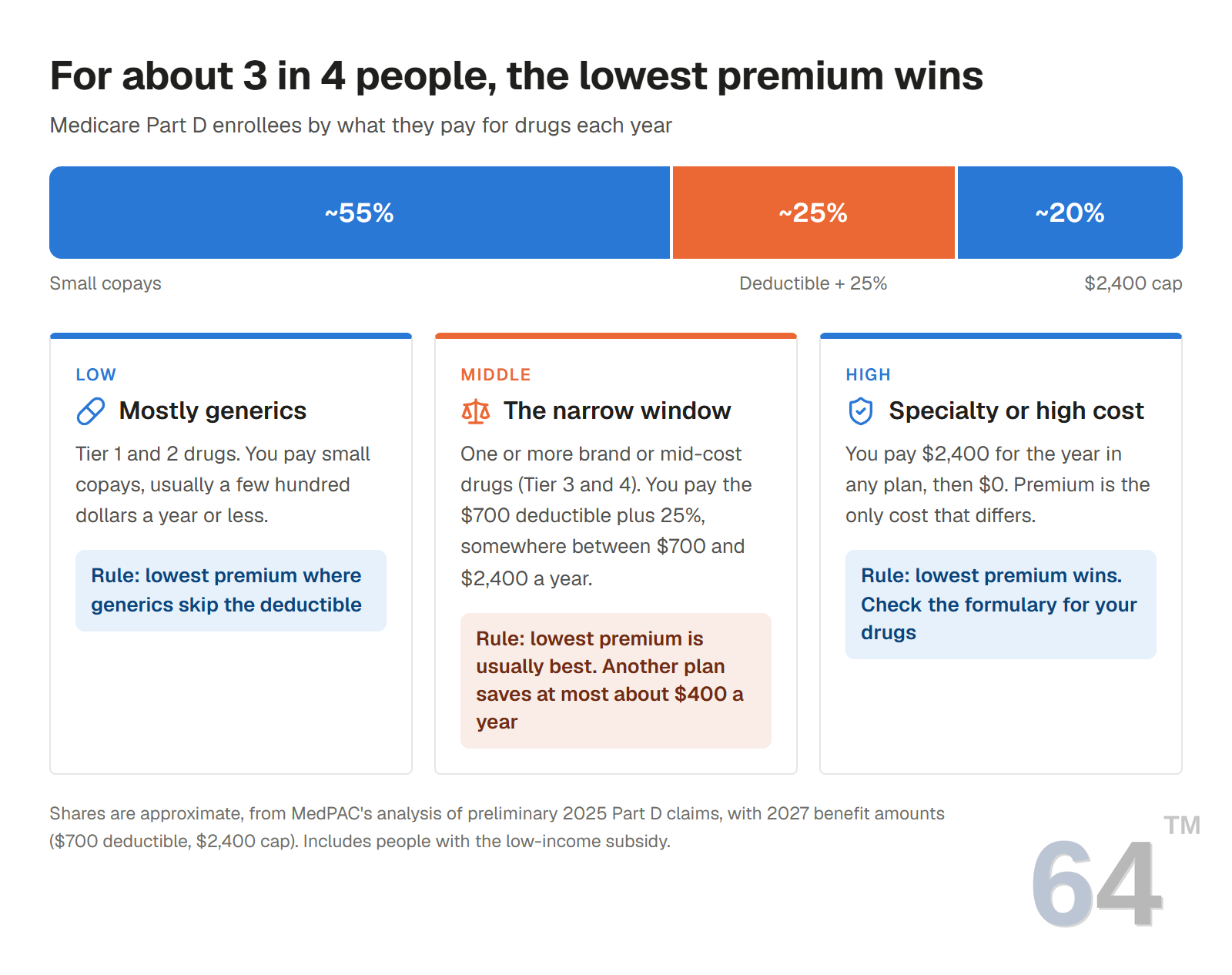
The window is everyone in between, about 1 in 4 people. You take one or more brand-name drugs, so you'll pay the $700 deductible, but not enough to reach the cap. Under the standard benefit you pay the full price until you've spent $700, then 25%, and you'd reach $2,400 at about $7,500 a year in total drug costs. Here, the plan's design does change what you pay.
Two Drug Lists, Eight Plans
I ran two middle-window lists through WhenIm64 against the eight 2027 stand-alone drug plans from the big national insurers in Texas, where WhenIm64's demo couple lives, filled by mail order. The first is three generics (metformin, atorvastatin and lisinopril) plus Jardiance, a brand-name diabetes drug. The second is metformin and atorvastatin plus Jardiance and Eliquis, a brand-name blood thinner. The totals are premium plus estimated drug costs for the year.
| Plan |
Monthly premium |
Generics + Jardiance |
Generics + Jardiance + Eliquis |
| Humana Basic |
$6.30 |
$1,129 |
$1,426 |
| Wellcare Value Script |
$5.30 |
$1,200 |
$1,573 |
| Wellcare Classic |
$7.30 |
$1,233 |
$1,602 |
| Humana Value |
$33.20 |
$1,349 |
$1,573 |
| Humana Premier |
$137.50 |
$1,919 |
$2,083 |
| SilverScript Choice |
$111.40 |
$2,445 |
$2,785 |
| AARP Medicare Rx Saver |
$115.70 |
$2,468 |
$2,775 |
| AARP Medicare Rx Preferred |
$199.00 |
$3,117 |
$3,416 |
Two things stand out. Picking well among the cheap plans saved $71 on the first list and $147 on the second, compared with simply taking the lowest premium. And the expensive plans lost by $650 to $2,000. The few hundred dollars are mostly in not paying for coverage you don't need.
That's also the penalty for not bothering. If you skip the comparison and take the lowest premium, you give up $71 or $147 a year on these lists. If you buy a richer plan to be safe, you give up hundreds to $2,000. Even in the window, the cheapest plan is the safer default, and the comparison is how you find the extra $100 or so.
To check that these two lists weren't flukes, I priced 728 more in four states, Texas, Massachusetts, Florida and California, at retail and by mail: three common generics plus one or two of 13 widely used brand-name drugs, among them Eliquis, Jardiance, Farxiga, Tradjenta, Trelegy and Spiriva. The comparison counts premium and drug costs together. In nearly 9 of 10 cases in the window, the lowest-premium plan was already the best plan, and the most it ever cost was about $400 for the year. The plans that beat it were other cheap plans. No plan costing more than $100 a month came out ahead once.
Why the Rich Plans Lose
Humana Premier is the clearest case. Its $350 deductible and flat copays cut drug costs on the first list to about $270 a year, against about $1,050 on Humana Basic. That's almost $800 saved on drugs. But its premium is $1,650 a year, about $1,575 more than Basic's, so it still loses by almost $800.
That's the pattern in the window. A richer plan saves you part of the deductible and some coinsurance, but the gap in premiums is usually bigger. Before you pay $100 a month or more for a Part D plan, run your list and see whether the drug savings cover it. On these lists, none did.
What Decides It Among the Cheap Plans
The three cheapest plans were within about $100 of each other on the first list and $180 on the second. What moved them:
- The deductible tag. Humana Basic charges full price for everything until you've spent $700, generics included. On a generics list that's a big penalty, as the last article showed. With brand-name drugs you'll pay the deductible on every plan anyway, so it matters much less, and Basic won both lists.
- The tier and price of each brand-name drug. Wellcare puts Jardiance and Eliquis on Tier 2 (T2); Humana puts them on Tier 3 (T3). The tier name doesn't settle it, though: after the deductible, each plan's percentage and the drug's price decide what you pay per month. That's why you need the actual numbers.
- The pharmacy. These figures are for mail order. At a retail pharmacy, Wellcare Value Script edges past Humana Basic on the first list. Run your list the way you'll actually fill it.
What the Labels Mean
Here's how to read WhenIm64's Part D results when you're in the window.
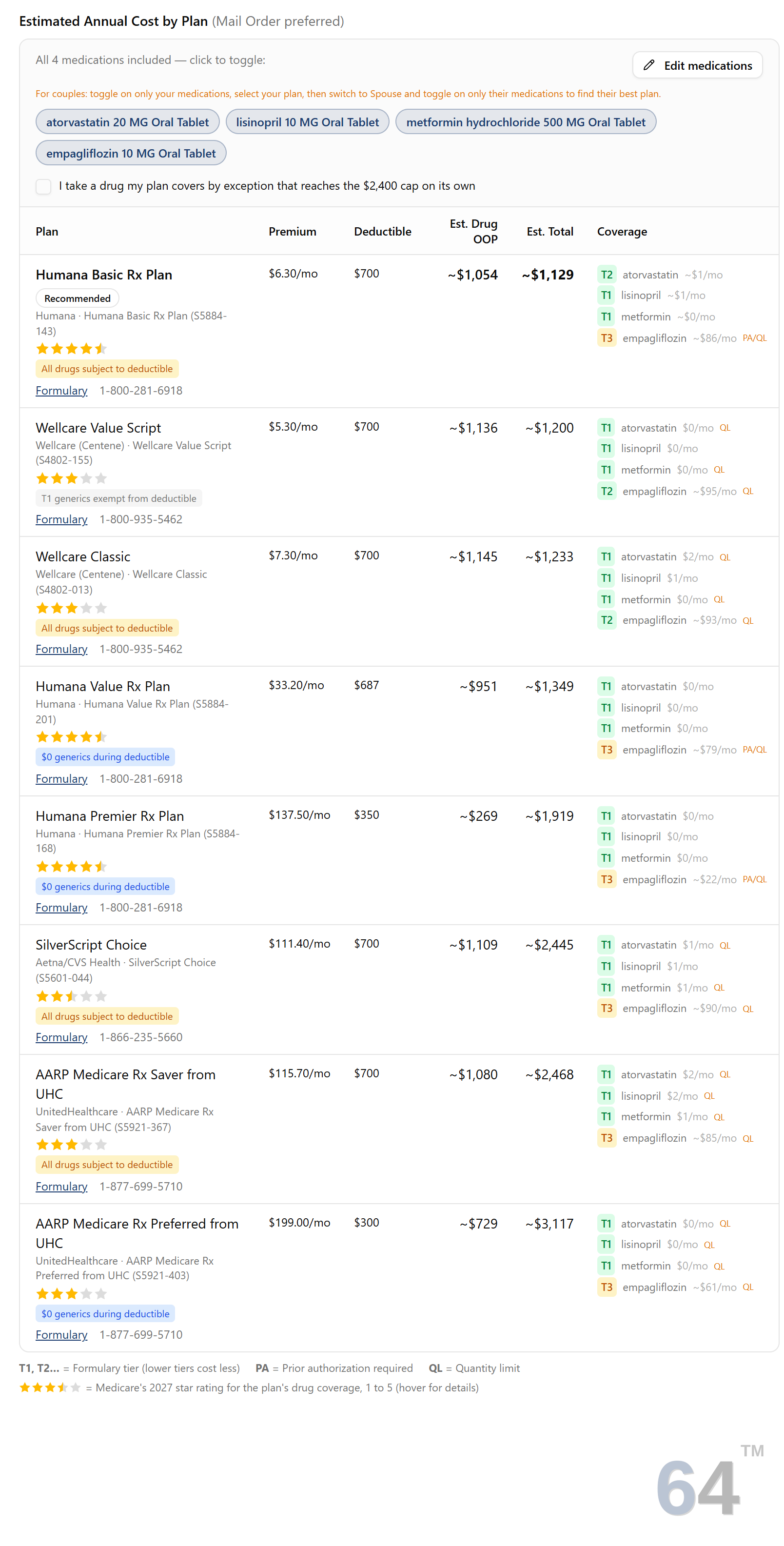
This is the first list from WhenIm64's demo. Look at the right-hand column first. Every plan covers all four drugs, so nothing says "Not on formulary". The generics are T1 or T2 and cost almost nothing, so Jardiance, listed under its ingredient name, empagliflozin, drives the cost. It's T3 on most plans and needs prior authorization on the Humana plans (PA/QL). Then look at the tags under the plan names. The recommended plan, Humana Basic, is tagged "All drugs subject to deductible": you pay the full price of every drug until you've spent $700. It still comes out ahead, on a $6.30 premium. The stars under each plan are its Medicare star rating, a good tiebreaker when two plans cost about the same.
Drugs come in three broad kinds. Generics are the cheap copies of drugs whose patents have expired. Brand-name drugs are still under patent or have no generic. Specialty drugs are the very expensive ones, often injectables or drugs for rare or complex conditions. Plans sort them into tiers, and WhenIm64 shows each drug's tier as a colored chip:
- T1 and T2 (green): preferred generics and generics. Usually a few dollars, often nothing.
- T3 (amber): preferred brand-name drugs.
- T4 and up (red): non-preferred drugs and the specialty tier. Specialty drugs usually cost a percentage of the price, not a flat copay.
A generic isn't a lesser drug. The FDA requires it to have the same active ingredient, strength and form as the brand, and to deliver the drug into your bloodstream the same way, within tight limits. Tamsulosin is Flomax for every practical purpose. When a generic exists, plans usually cover it and put the brand on a higher tier or leave it off, and they're entitled to. Getting the brand covered takes a documented medical reason from your doctor's office, not a preference. "Dispense as written" on the prescription won't do it. The real reasons are narrow: an allergy to an inactive ingredient, a few drugs where small differences matter (levothyroxine, warfarin, some seizure medications), and the occasional extended-release generic that doesn't behave like the brand. If a brand-name drug in your list has a generic, ask your doctor whether the generic would work. It's the quickest way out of the window.
Next to the tier you may see restrictions:
- PA, prior authorization: the plan wants your doctor to justify the drug before it pays.
- ST, step therapy: you have to try a cheaper drug first.
- QL, quantity limit: the plan caps how much you can get per fill.
Two other cases have their own rules. Insulin is capped at $35 a month, with no deductible, on every plan. And some brand-name drugs, Jardiance and Eliquis among them, now have prices negotiated by Medicare, which makes them cheaper than they were but doesn't make them free.
Each drug name above the table is a button. Click one to drop it from the comparison and see how much that drug alone is driving your costs.
Why I Built It This Way
I built the Part D comparison in WhenIm64 because of that first mistake. Comparing premiums is easy; comparing what you'll actually pay is not, and in the window it's the only comparison that counts. WhenIm64 prices your drugs on every plan in your region using Medicare's own plan data, applies each plan's deductible rules and the cap, and ranks the plans by what you'd actually pay for the year. You can see how it works in WhenIm64's demo, which compares plans for a couple in Austin, Texas. To compare the plans in your own state with your own drugs, create a WhenIm64 account.
Open enrollment ends December 7. If you take a brand-name drug, run your list before then. Ten minutes may tell you that the plan you have costs a few hundred dollars more than one that would cover you just as well.
Ben Sprachman is the founder of WhenIm64.ai, a retirement planning tool for people navigating retirement. He is not a financial advisor or tax professional. This article is for educational purposes only. Consult a qualified tax advisor for guidance specific to your situation.