Someone in my family was prescribed a drug that isn't on any national Part D plan's formulary. Their $8-a-month plan approved it anyway. When I added a way to handle that in WhenIm64, every plan's drug cost came out as the same number, and the whole comparison collapsed to one question: which plan has the lowest premium? With open enrollment ending December 7, it's the question most people should start with.
That made me rethink how much the formulary really matters. For most people, it's less than the hours we spend on it.
The Number That Changes Everything
Starting in 2025, every Part D plan has a cap on what you pay for covered drugs in a year. It's $2,100 in 2026 and $2,400 in 2027. Once you reach it, the plan pays for your covered drugs for the rest of the year. Every plan has the same cap, from the $5-a-month plan to the $199-a-month plan.
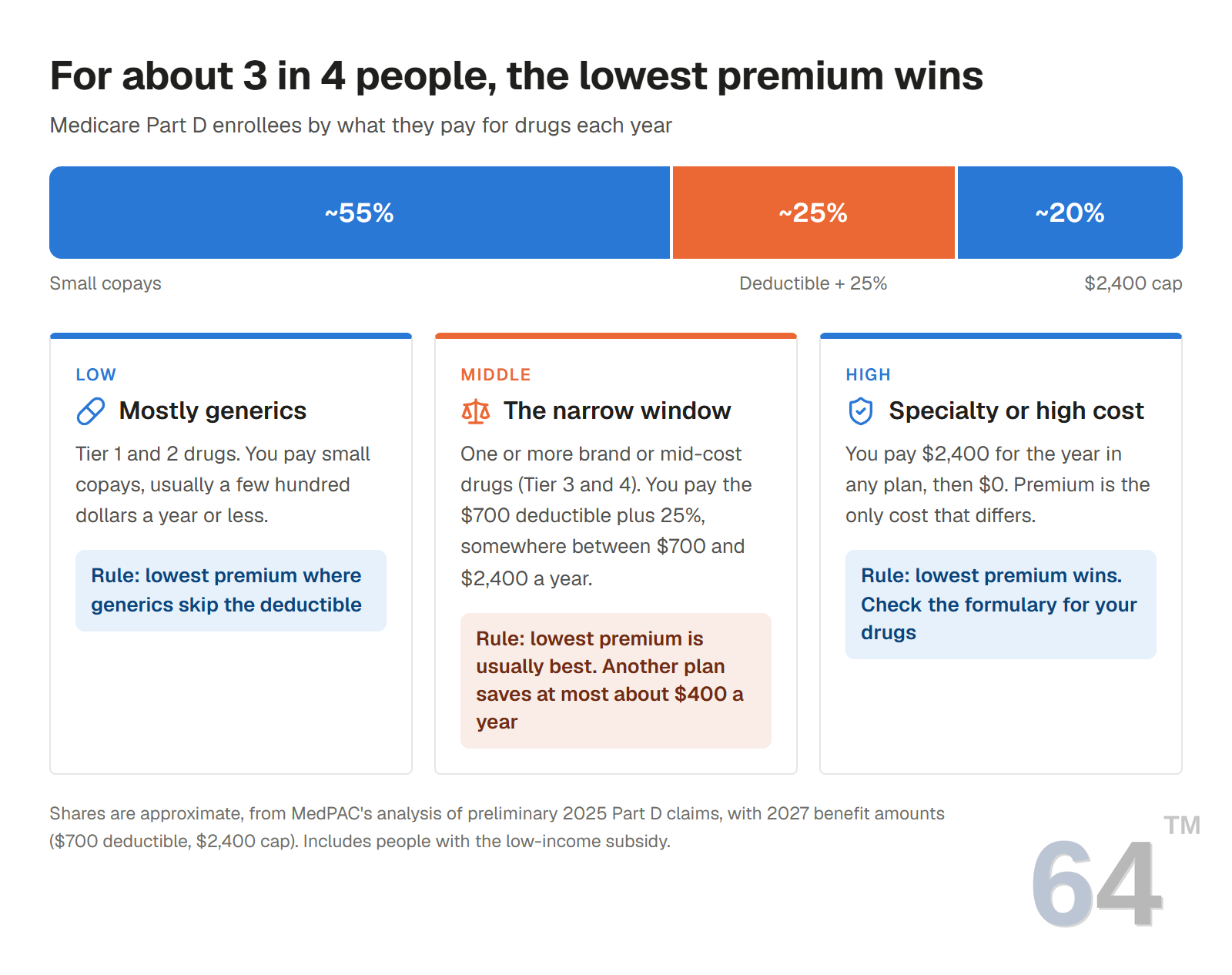
That means where your yearly drug costs land decides what you should care about. I think of it as three zones.
- Low: no regular prescriptions, or a few common generics. You pay small copays, usually a few hundred dollars a year or less.
- Middle: one or more brand-name drugs, enough to pay the $700 deductible but not enough to reach the $2,400 cap.
- High: a specialty drug, or anything expensive enough to reach the cap. You will pay the $2,400 no matter which plan you pick.
The high zone isn't rare. In 2025, the first year of the $2,000 cap, 22% of people in Part D reached it, up from 8% the year before, according to MedPAC's analysis of preliminary claims. Put MedPAC's spending figures against the 2027 amounts and roughly 55% of people land in the low zone, 25% in the middle and 20% in the high zone.
For the low and high zones, about 3 in 4 people, the lowest premium wins.* There's one check in each, and neither one is reading formularies line by line. The middle zone is the only place where comparing plans pays, and I cover it in the next article.
* For the national drug plans, in every state except Hawaii. In 2027 the lowest-premium national plan in those states, Wellcare Value Script, also lets Tier 1 generics skip the deductible.
Low Zone: The Lowest Premium, With One Check
To test this, I ran a typical generics list through WhenIm64 against the eight 2027 stand-alone drug plans from the big national insurers in Texas, where WhenIm64's demo couple lives: atorvastatin, amlodipine, lisinopril and levothyroxine. The totals are premium plus estimated drug costs for the year.
Wellcare Value Script, the plan with the lowest premium at $5.30 a month, costs about $64 for the year. It charges nothing for these generics, even before the deductible. The most expensive plan, AARP Medicare Rx Preferred, also charges nothing for them and costs $2,388, all of it premium.
The check is how the plan treats generics during the deductible. Every 2027 national plan has a deductible, up to $700, and some make you pay full price for every drug, generics included, until you've spent it. Humana Basic is only a dollar a month more than Wellcare Value Script, but it applies the deductible to everything. The same four generics cost about $193 there, three times as much. On a generics list, that's the difference that matters.
So in the low zone, pick the lowest premium among plans where generics skip the deductible. WhenIm64 tags every plan with how it handles this: look for "$0 generics during deductible", "T1 generics exempt from deductible" or "No deductible", and avoid "All drugs subject to deductible". For a "T1 generics exempt" plan, check that your generics are on Tier 1 (T1). It takes a minute.
High Zone: You'll Pay $2,400 Anyway
I ran a specialty list too: Enbrel plus a generic. Every plan hits the $2,400 cap. The totals run from $2,464 to $4,788, and the entire $2,324 difference is premium. The formulary, the tiers, the copays: none of it changes what you pay.
The check here is coverage. The cap only counts drugs the plan covers. A drug the plan doesn't cover is outside the cap, so you'd pay full price for it, and none of that counts toward the $2,400. So pick the lowest premium among plans that cover all your drugs. If none of them covers a drug you need, that's what formulary exceptions are for.
When Your Drug Isn't on the Formulary
"Not on the formulary" doesn't mean "not covered". Every Part D plan has to have an exception process, and it's the same process at every price. A more expensive plan doesn't buy you a better chance.
The work falls on the doctor's office that writes the prescription, not on you. The office sends the plan a statement saying the drugs the plan does cover would be less effective for you, would cause side effects, or have already failed. The plan has to approve the exception when it finds, based on that statement, that the drug is medically necessary. You're allowed to start the request yourself, but without the doctor's statement it goes nowhere. Your job is to make sure the office knows the plan needs one, and to keep after them until it's sent. Exceptions can also waive step therapy or a quantity limit on a drug that is on the formulary.
The clock starts when the plan gets the doctor's statement:
- The plan decides within 72 hours, or 24 hours if waiting could seriously harm your health.
- If it says no, the office can ask it to reconsider. The plan has 7 days, or 72 hours if expedited.
- If it says no again, the next step is the Independent Review Entity, which works for Medicare, not the plan. There are 60 days to ask, and further levels after that.
Our family member's request was turned down twice before it was approved, about a week after the first try. That's not unusual. Don't give up on the first no, and don't let the doctor's office give up either.
Once a drug is approved, the plan can't put it on a special, more expensive tier just for exceptions, and what you pay counts toward the $2,400 cap. If the drug is expensive, that's the end of the comparison: you'll reach the cap, so the plan with the lowest premium costs least.
Does a Pricier Plan Ever Help?
Nobody publishes how often each plan approves exceptions, so you can't shop on that. What you can see is each plan's formulary, and it puts your drug in one of these cases:
- On the cheap plan's formulary. No exception needed. Pick the lowest premium, after the one check for your zone: generics that skip the deductible, or coverage for all your drugs.*
- On no plan's formulary, with no real alternative. That was our family member's situation. Every plan needs an exception, and every plan works under the same rule. A $199-a-month plan doesn't buy better odds than an $8 one.
- Not on this plan's formulary, but the plan covers a similar drug. This is the one case where a pricier plan can help. If your doctor can't show the covered drug is worse for you, the plan can legitimately say no, and an appeal will usually lose too. A brand-name drug with a generic is the most common example. If you need that specific drug and it's only on a more expensive plan's formulary, that plan buys you certainty. Check the middle-priced plans first; one of them may cover it for much less.
- Excluded by law, or prescribed off-label without support in the standard drug references. Drugs for weight loss, cosmetic use or fertility are outside Part D altogether, and so are over-the-counter drugs. No plan pays for them at any premium.
* For the national drug plans, in every state except Hawaii, the lowest-premium plan passes the generics check: in 2027 it's Wellcare Value Script, whose Tier 1 generics skip the deductible.
So decide by the formulary, not by guessing at exceptions.
What's the Penalty for Picking Wrong?
Picking the lowest premium is a bet that you won't need something the plan handles badly. So what does losing that bet cost?
- Low zone: nothing, as long as the plan's generics skip the deductible.
- High zone: nothing. Every plan stops at the same $2,400.
- Middle zone: tens of dollars to a few hundred. In the two brand-name drug lists I ran for the next article, the lowest-premium plan cost $71 and $147 more than the best plan for the year.
To see how far that goes, I priced 728 drug lists in four states, Texas, Massachusetts, Florida and California, at retail and by mail: three common generics plus one or two of 13 widely used brand-name drugs, counting premium and drug costs together. In nearly 9 of 10 middle-zone cases, the lowest-premium plan was already the best plan. The most it ever cost was about $400 for the year.
The bigger worry is usually a drug you don't take yet. If your doctor prescribes a brand-name or specialty drug next spring, the cap still protects you on the cheap plan, as long as the plan covers the drug or approves it by exception. On Wellcare Value Script, the worst case for the year is its $64 premium plus the $2,400 cap, about $2,464. AARP Medicare Rx Preferred's premium alone is $2,388, before you've filled a single prescription.
That's why I think of the lowest-premium plan as self-insuring. The richer plans charge hundreds to more than $2,000 a year in extra premium to protect you from a loss of a few hundred dollars. For most people that insurance doesn't pay off. And if your drugs change, you can pick again at the next open enrollment.
The Catch at Open Enrollment
An exception is approved by one plan for one plan year. The plan may choose to continue it into the next year if you stay, but it doesn't have to. Before December 7, ask your plan whether your exception carries into 2027.
If you switch plans, assume you start over. The new plan must give you a temporary supply of a drug you already take, usually a month's worth in the first 90 days, while the doctor's office files a new request. For someone whose approval took two denials, that's a real reason to stay put. In my 2027 Part D article I said I might keep a more expensive plan for exactly that reason.
If you'll hit the cap, look at the Medicare Prescription Payment Plan. Every Part D plan must offer it. Instead of paying the $2,400 at the pharmacy in January, you pay it in monthly bills over the rest of the year. It spreads the cost over the months left, so it works best when you start at the beginning of the year.
So It Comes Down to Two Things
If you're in the low or high zone, choose by two things.
The premium. Your drug costs are either tiny or fixed at $2,400, so the premium is the difference between plans, once you've made the one check for your zone.
How easy the plan is to deal with. If you take an expensive drug, you may spend time with your plan on approvals and refills. Medicare's star ratings are the public measure of that. For drug plans, the ones that matter most are "Getting Needed Prescription Drugs", "Complaints about the Drug Plan", "Members Choosing to Leave the Plan" and "Rating of Drug Plan". WhenIm64 now shows each plan's rating next to its cost, with those four measures when you hover over the stars, and Medicare's Plan Finder has them too. A plan with a rock-bottom premium and poor ratings might cost you more in phone calls than it saves.
If you take one or more brand-name drugs and won't reach the cap, you're in the middle zone, and the details do move the numbers. That's the next article.
Why I Built It This Way
I built the Part D comparison in WhenIm64 after I picked the wrong plan the first time. Comparing premiums is easy; comparing what you'll actually pay is not. WhenIm64 prices your drugs on every plan in your region using Medicare's own plan data, applies each plan's deductible rules and the cap, and ranks the plans by what you'd actually pay for the year. If you take a drug a plan covers by exception, check "I take a drug my plan covers by exception that reaches the cap on its own", and every plan's drug cost becomes the cap, so you can see which premium is lowest. You can see how it works in WhenIm64's demo, which compares plans for a couple in Austin, Texas. To compare the plans in your own state with your own drugs, create a WhenIm64 account.
Open enrollment ends December 7. If you do nothing, your plan renews at its 2027 premium, with its 2027 formulary. Spend ten minutes figuring out which zone you're in. It may save you hours of comparing copays that won't change what you pay.
Ben Sprachman is the founder of WhenIm64.ai, a retirement planning tool for people navigating retirement. He is not a financial advisor or tax professional. This article is for educational purposes only. Consult a qualified tax advisor for guidance specific to your situation.